


You bought the rug. You rolled it out. And somehow the whole seating area looks worse than it did on bare concrete. The chairs sit half on, half off. There is a border of rug showing on one side and none on the other. It reads as a mat somebody dropped, not as a floor.
Almost every rug that looks wrong outdoors was bought by eye. Someone stood in a store aisle, guessed at a size, and picked the one that seemed about right. Most patio rug ideas you scroll past skip the part that actually decides the outcome, which is a tape measure and about ten minutes of arithmetic before you spend a dollar.
This guide runs in two halves. The first six steps happen before you buy, where you measure your furniture, add the right border, land on a real size, and choose a fiber that survives your specific weather. The last four happen on the patio, where you clean, flatten, place the furniture in a set order, and keep the rug from creeping.
Budget about 20 minutes for measuring and roughly an hour for placement once the rug arrives. Grab a tape measure and a notepad. Your furniture is about to tell you exactly what size to buy.
Also read: DIY Solar Jar Lanterns You Can Make for Under 10 Dollars
Measure the furniture footprint, not the patio
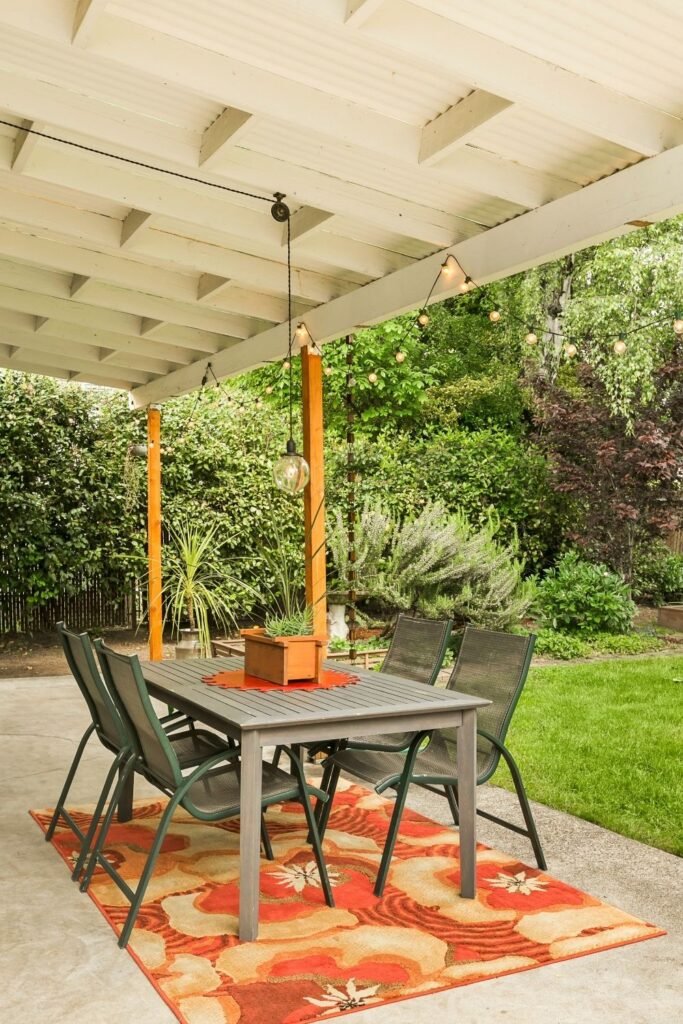
Your patio dimensions do not decide your rug size. Your furniture does. Push the seating group into the arrangement you actually want, then measure the rectangle those pieces sit inside, corner to corner at the widest points. Write down both numbers. A pair of chairs with a table between them might occupy 7 by 5 feet on a patio that runs 14 feet across, and the patio number is the one that leads people wrong.
Add 24 inches to each side of that measurement
Border is what separates a rug from a mat. Take your footprint numbers and add 2 feet to every side, which means 4 feet total to the length and 4 feet total to the width. A 7 by 5 foot footprint becomes a target of 11 by 9 feet. That border is the visible margin around the furniture, and it is the single detail that makes the setup look planned instead of accidental.
Round up to the nearest standard rug size
Rugs come in fixed sizes, so your target number will almost never match one exactly. Round up, never down. An 11 by 9 foot target becomes a 10 by 14 foot rug, or a 9 by 12 foot if the larger one crowds your walking path. Check the smaller option against your space before deciding, since a rug that runs past the edge of the slab collects dirt from the grass and frays along that side within a season.
Match the rug shape to your table shape
If your table is round and your rug is a hard rectangle, the mismatch shows most in photos taken from the doorway. Shapes that agree with each other look settled. Use these pairings as your starting point:
- Round table, round or square rug
- Rectangular table, rectangular rug
- Long narrow patio, runner plus a small rectangle
- Sectional or L-shaped seating, oversized rectangle
Break the pairing only when your walking path forces it.
Choose a fiber that survives your weather
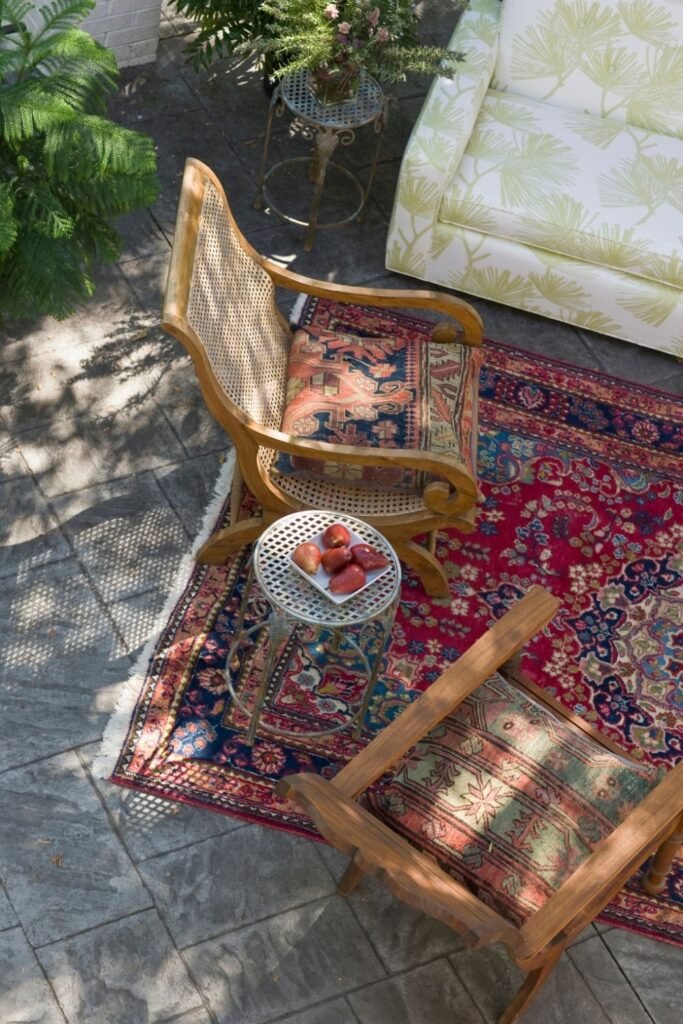
Polypropylene handles almost every climate and costs the least, which is why it fills most of the outdoor aisle. Recycled PET feels softer underfoot and holds color longer in strong sun, so it earns the higher price in southern yards that bake all afternoon. Both dry within a few hours after rain. Check the label for UV-stabilized or fade-resistant wording before you buy, because an untreated synthetic rug can go visibly pale in a single season under direct sun. Covered porches give you more freedom here since the rug never takes a direct soaking.
Pick a pattern that hides what your patio actually collects
Walk out and look at what lands on your floor between sweeps. Yellow pollen, red clay dust, dark leaf litter, or pale sand each show up differently. Most patio rug ideas online lean toward soft cream and pale gray, and those two colors surrender to pollen faster than anything else. Mid-tone patterns with two or three colors running through them hide the mess between cleanings without looking busy.
Sweep the surface and check that it is bone dry
Two passes with a stiff broom, running in opposite directions, pulls up more grit than four passes going the same way. Get into the corners and along the house wall where leaves pack down. Then press a paper towel flat against the concrete for 30 seconds and lift it. Any darkening means the slab still holds water, and the rug has to wait.
Unroll the rug and let the sun flatten it
Fold creases from shipping look permanent and are not. Roll the rug out on the empty slab, weight the corners with anything heavy, and give it 4 to 6 hours of warm daylight. Heat relaxes the backing on its own. Setting furniture on a creased rug locks those ridges in place instead.
Place the furniture back in a set order
Working outward from the center keeps everything square, because each piece lines up against something already placed rather than against your best guess. Start with the table dead center, then measure from the rug edge to confirm it. Bring the seating in after that, one piece at a time:
- Set the table centered on the rug
- Add the two main chairs facing each other
- Fill remaining seats around the open sides
- Check that front legs sit at least 6 inches in from the rug edge
Step back to the doorway before you commit. That is the angle you will see every day, and it is where a crooked table shows up first.
Lock the rug down and set a rinse routine
Corners lift first, and a lifted corner catches wind until the whole rug slides. An outdoor rug pad solves most of it by adding grip and letting air move underneath. Add grippers or outdoor double-sided tape at each corner if your patio is exposed. Then put a reminder on your phone for every three weeks: lift the rug, hose both the rug and the slab, and let each dry separately before the rug goes back down. That one habit is what decides whether the rug lasts one season or five.
Frequently Asked Questions
What size rug do I need for a standard patio table and four chairs?
Measure the set first, but a typical four-seat dining group needs a 9 by 12 foot rug. The reason is chair pullback. A chair slides back roughly 20 inches when someone stands up, and if the rug ends before that, the back legs drop off the edge and catch every single time. For a smaller bistro set with two chairs, a 6 by 9 foot rug usually clears it. Sectionals need the biggest jump, often 10 by 14 feet, because the L-shape occupies far more floor than it appears to from a photo.
Should the rug touch the edges of my patio?
Leave a border of bare surface showing on all sides, ideally 12 to 18 inches. A rug that runs wall to wall reads as cheap carpet rather than a defined seating area, and it removes the visual frame that makes the space look intentional. Practically, a rug that hangs past the slab onto grass or dirt wicks moisture up into the backing and frays along that edge within a season. On a very small balcony you can drop the border to 6 inches and it still works.
Do I really need a rug pad outdoors?
More than you do indoors, honestly. Outdoor pads are made from open mesh rather than solid felt, so their main job is airflow rather than cushioning. That gap lets water drain through and air circulate, which stops the dark damp shadow that forms under a rug lying flat on concrete. The pad also stops sliding, which matters on smooth or sealed surfaces where a rug can travel several inches in one windy afternoon. Expect to spend 25 to 60 dollars depending on size.
How do I stop my outdoor rug from blowing away?
Weight and grip together, not either alone. Furniture on top handles most of it, which is another argument for sizing the rug so chair legs actually land on it. For the corners, outdoor double-sided rug tape holds well on clean concrete, and rubber-backed grippers work on wood decking. On a high balcony or an exposed corner lot, add landscape staples through the corners if the surface allows it. Roll the rug up and store it inside when a real storm is forecast.
Can I put an outdoor rug on a wood deck?
Yes, with one non-negotiable condition, which is that you lift it regularly. Wood is far less forgiving than concrete because trapped moisture softens the boards and speeds up rot underneath. Use an open-weave pad, and lift the rug every two to three weeks in wet months so both surfaces dry. Watch the deck stain too, since a rug sitting in one spot all summer leaves a visibly lighter rectangle when the surrounding boards fade in sun.
How long does an outdoor rug actually last?
A polypropylene rug in full sun typically holds up for two to three seasons before the color noticeably fades and the weave starts shedding fibers. Recycled PET usually runs a season longer, and a rug on a covered porch can go five years or more since it avoids both direct UV and standing water. The rinse routine matters more than the price tag. A cheap rug that gets lifted and hosed regularly outlasts an expensive one left flat on wet concrete all summer.
Can I cut a large outdoor rug down to fit my space?
Only if it is a flat-weave synthetic with a bound or fused edge, and even then the cut side will unravel unless you finish it. Run a bead of clear fabric glue or a fold of outdoor binding tape along the raw edge, then press it flat overnight. Machine-woven rugs with a rubber backing cut more cleanly than looped or shag styles, which shed immediately. Buying the correct size costs less frustration than salvaging a wrong one.
Your Rug Fits Now
The measuring is done and the guessing is over. That is what most people skip.
Live with it for a week before adding anything else. You will notice whether the walking path still feels open, and that tells you if the size was right.
The best patio rug ideas come down to one number: your furniture footprint plus 24 inches on every side. Same math works on a balcony, a deck, or a covered porch.
Pin this so the sizing chart is there when you are standing in the store aisle.