

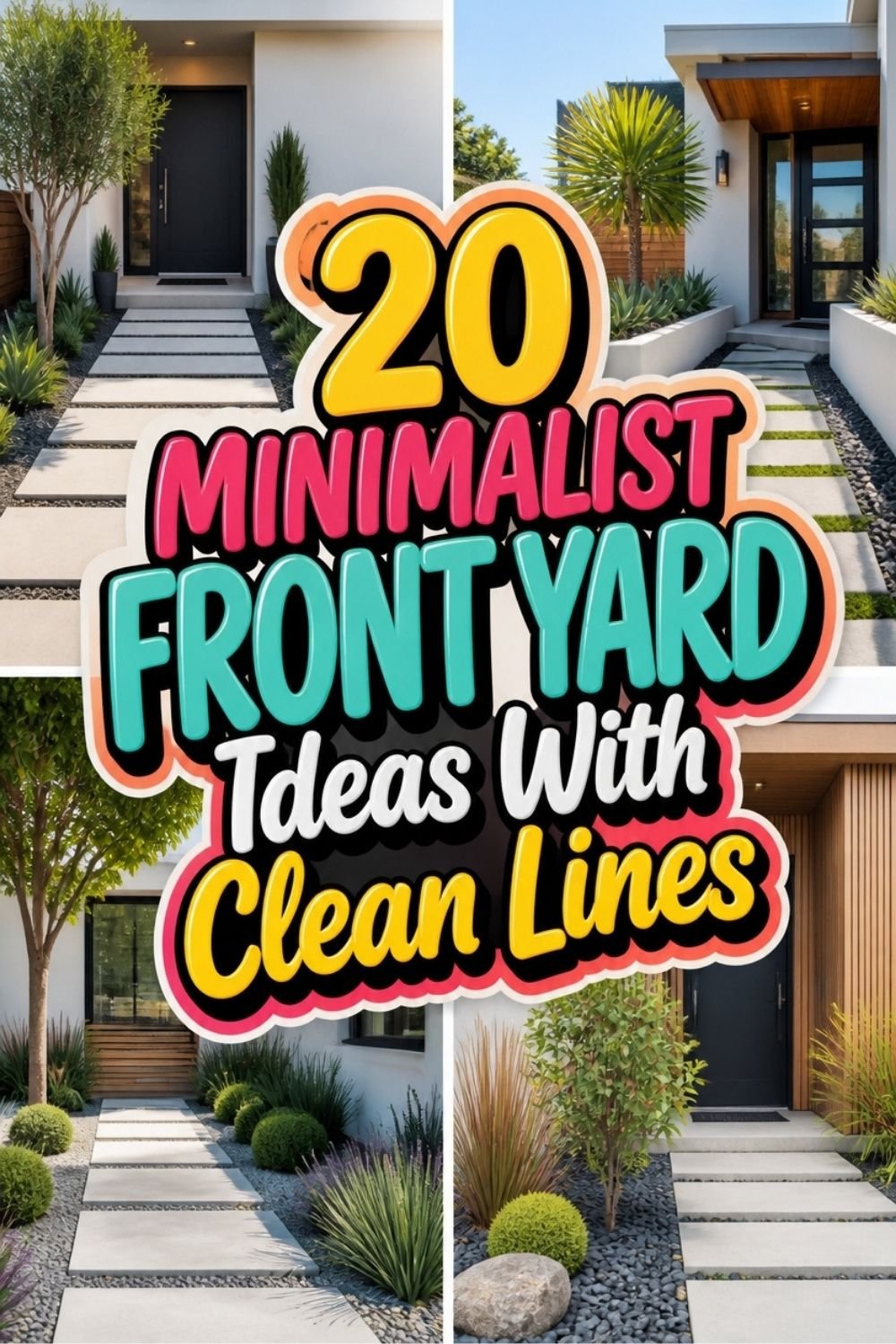
Minimalist front yard design strips away excess to reveal essential beauty through deliberate restraint. Clean lines guide movement, while limited materials create visual coherence across the space. The approach demands careful planning, since every element must earn its place through function or form. Twenty distinct strategies exist for achieving this aesthetic, each addressing specific challenges of entryways, plantings, and spatial organization. The transformation begins with understanding which principles apply to your particular site conditions.
Define Minimalist Front Yard Design Principles First
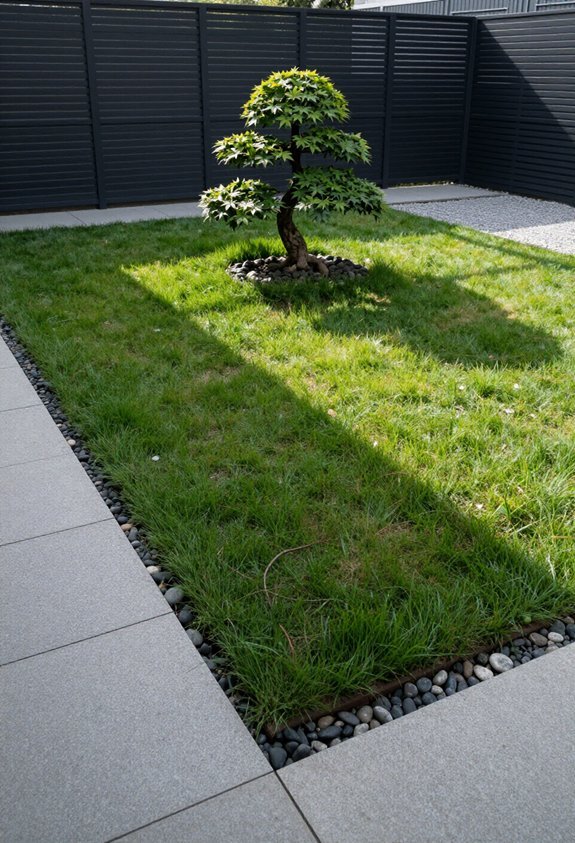
Precision serves as the foundation for any successful minimalist front yard, requiring homeowners to understand several core principles before making physical changes to their outdoor space. Minimalist design relies on intentional reduction, where every element earns its place through function or visual contribution. Negative space operates as an active component rather than absence, creating breathing room that highlights chosen features. Material selection demands consistency, limiting palettes to three or fewer textures viewed simultaneously. Scale relationships between built elements and plantings require careful calibration to maintain proportional harmony. Color restraint follows similar logic, with neutral bases supporting limited, deliberate accents. Maintenance considerations factor into principle application, as simplified layouts reduce ongoing demands. These interconnected guidelines establish the conceptual framework necessary for coherent execution, ensuring subsequent decisions align with minimalist objectives rather than accumulating visual clutter through unstructured choices.
Also read: 18 FRONT YARD PARTY SET UP Ideas For Hosting!
Start With a Statement Concrete Walkway
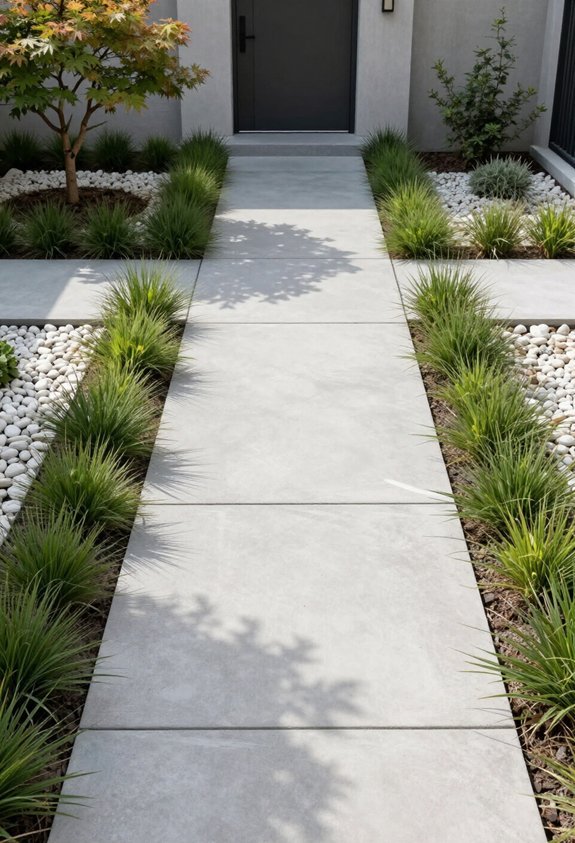
Once the foundational principles of minimalist design are understood, practical application begins with the walkway, as this element establishes the primary axis around which all other front yard components organize themselves. A statement concrete walkway functions as both functional pathway and visual anchor, its geometric precision directing movement while creating spatial order. The material selection demands attention: poured concrete offers seamless continuity, while precast slabs introduce rhythmic repetition through uniform dimensions. Surface treatments vary in texture, from smooth finishes that reflect light to broomed patterns that provide subtle traction and shadow variation. Width calculations follow practical necessity, typically spanning thirty-six to forty-eight inches to accommodate simultaneous passage. Color selection remains restrained, with natural gray tones or integrally mixed pigments in charcoal or warm beige maintaining visual coherence. Expansion joints, placed at calculated intervals, control cracking while contributing to the linear aesthetic. Edge restraint, whether steel, aluminum, or concrete curb, maintains crisp boundaries against adjacent materials.
Replace Your Lawn With Structured Gravel
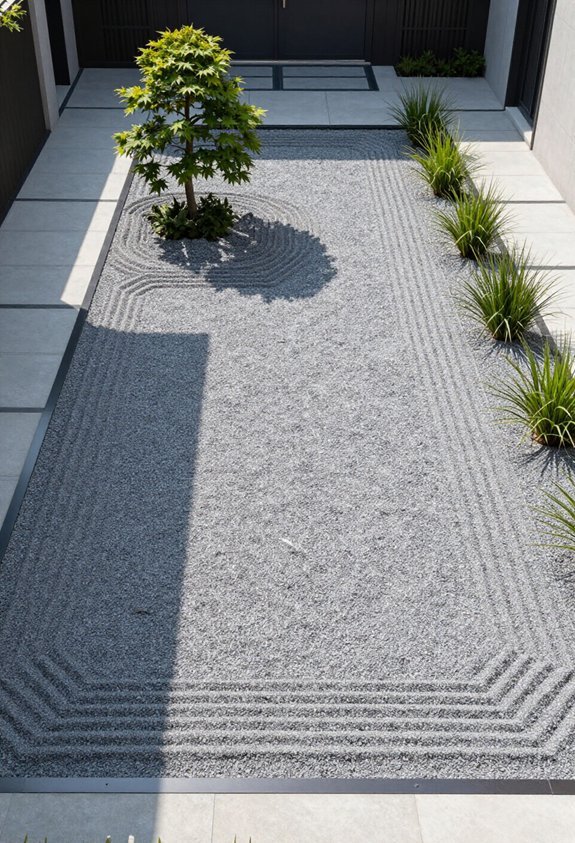
Remove the lawn and install structured gravel to create a clean, low-maintenance ground plane that extends the minimalist aesthetic established by the concrete walkway. Select crushed stone between three-quarter inch and one inch in diameter, ensuring uniform sizing for a smooth, stable surface. Install metal or concrete edging to contain the gravel, maintaining crisp boundaries that align with the walkway’s geometry. Excavate the soil to a depth of four inches, lay landscape fabric to suppress weeds, and spread the gravel in compacted two-inch layers. The resulting surface eliminates mowing, watering, and fertilizing demands while providing superior drainage. Light gray or warm tan stones complement concrete tones, reinforcing visual continuity across the front yard. This substitution reduces maintenance hours considerably and establishes a cohesive, tranquil environment.
Create Rhythm With Patterned Paver Spacing
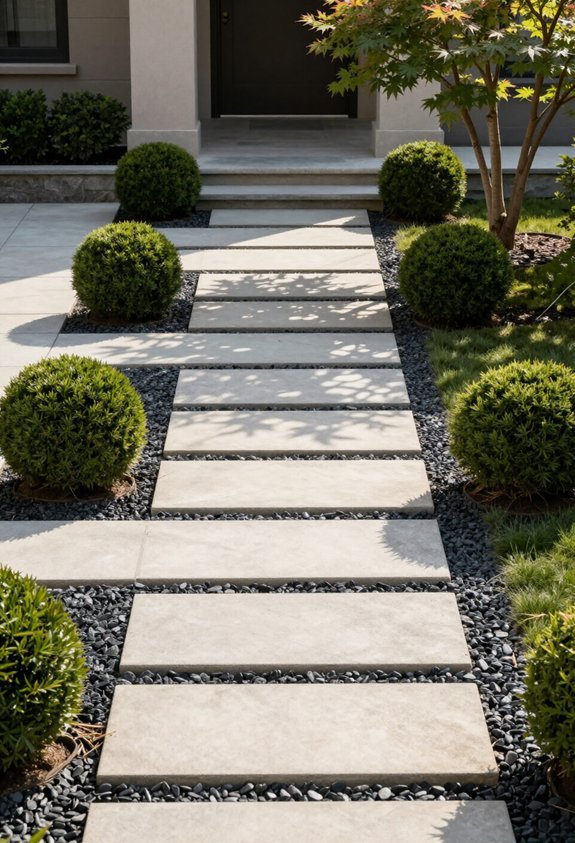
While gravel provides a continuous, uniform surface, introducing paved elements breaks the expanse into measured intervals that guide movement and sightlines through the yard. Pavers placed in deliberate patterns create visual rhythm, transforming flat terrain into structured sequences that organize spatial experience.
Spacing determines pattern density and functional purpose. Narrow gaps between rectangular pavers produce dense, walkable surfaces suitable for primary paths, while wider intervals allow gravel or ground cover to fill intervening spaces, softening visual impact and reducing material costs. Linear arrangements emphasize directional flow toward entry points, whereas staggered or grid formations generate geometric interest without decorative excess.
Proportion matters: paver dimensions should relate to yard scale and building architecture. Consistent spacing maintains clean lines essential to minimalist design, yet subtle variations in interval width can mark changes between circulation zones and resting areas without additional elements.
Frame Your Entry With Geometric Planters
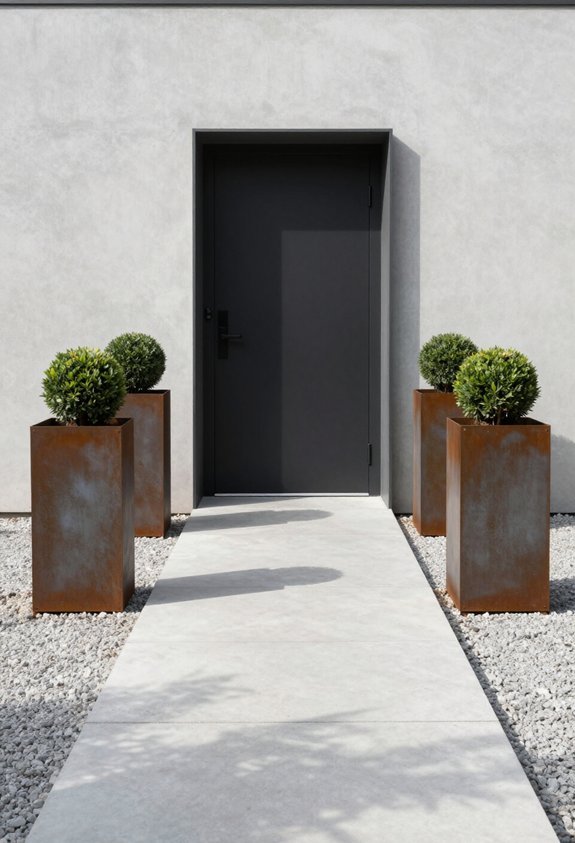
Several precisely shaped containers positioned symmetrically around a doorway establish immediate visual order and direct attention toward the threshold, functioning as architectural punctuation that announces the passage from public to private space. Cubes, rectangular prisms, and cylinders in concrete, metal, or ceramic provide the clean edges essential to minimalist design, while their uniform heights maintain horizontal continuity that complements the door’s vertical emphasis. Plant selection remains restrained, typically limited to single specimens of architectural succulents, clipped boxwood spheres, or tall, narrow grasses that reinforce geometric themes without visual clutter. Color palettes stay neutral, allowing material textures to create subtle variation. Spacing between containers demands precision, with equal distances from the door frame and consistent intervals between vessels ensuring balanced composition. This calculated arrangement transforms entryways into deliberate transition areas.
Line Your Driveway With Uniform Grasses
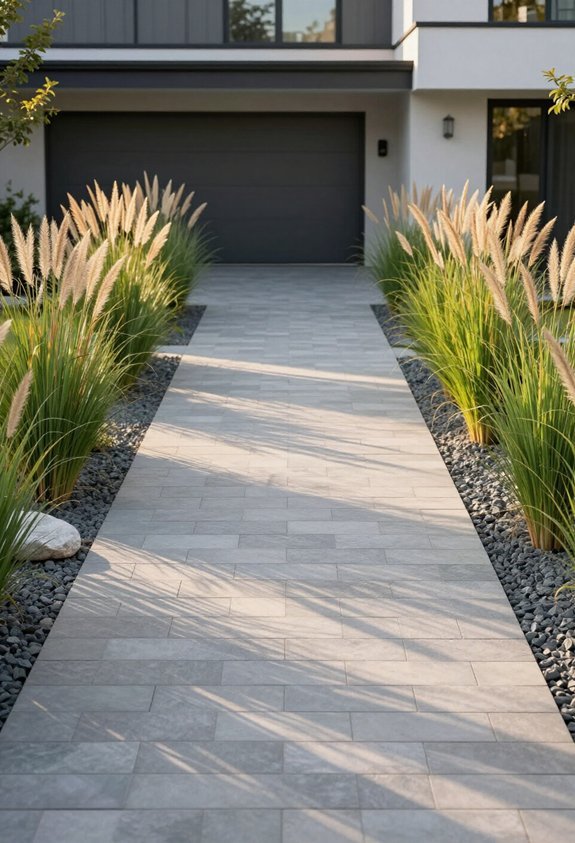
The disciplined attention given to entryways extends naturally toward the property’s edge, where the driveway presents an opportunity to establish linear rhythm through repeated plant forms. Uniform grasses, spaced at measured intervals, create visual continuity between hardscaping and softscaping. This geometric approach requires selecting specimens of identical height and habit—feather reed grass or upright fescue work well—planted in a single row or parallel formation flanking the pavement.
Spacing determines success: too tight creates maintenance congestion, too loose destroys the intended pattern. Installers should mark positions with stakes before digging, ensuring equal distances from driveway edge to plant center. Soil preparation remains consistent across all holes, matching existing grade to prevent water pooling.
The result reads as architectural punctuation rather than casual landscaping. Mowing strips or steel edging maintain the crisp separation between concrete and vegetation, eliminating irregular encroachment. Seasonal mowing of grasses to uniform height—typically late winter—renews the clean silhouette without demanding complex schedules.
This method prioritizes function: the driveway remains fully usable, sight lines stay clear for vehicle operation, and the palette restrains itself to two elements, surface and plant, rendered in repetition. The front yard consequently communicates intention through restraint, not accumulation.
Build a Floating Timber Deck for Contrast
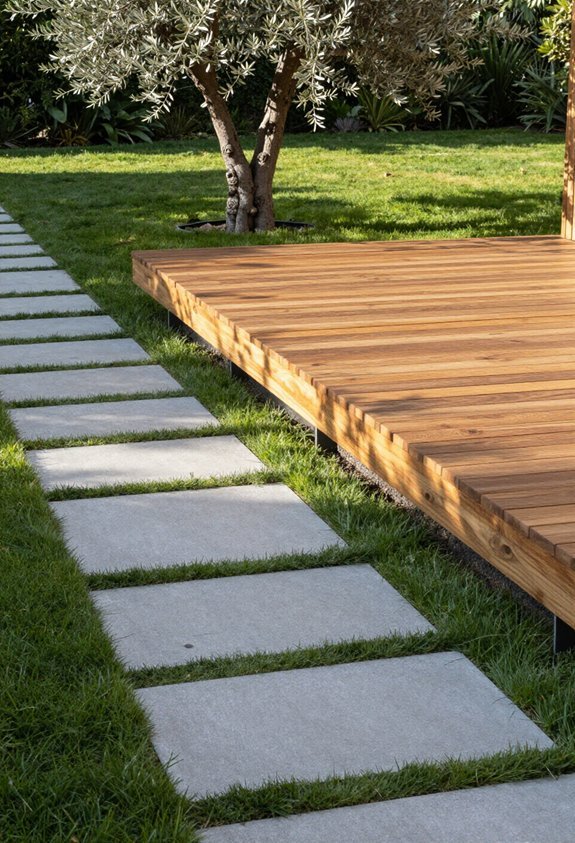
Introduce a floating timber deck to establish deliberate contrast against the disciplined order of paved surfaces and linear plantings that define the minimalist front yard. The deck sits slightly above ground level, supported by hidden posts that create the illusion of suspension, its warm grain interrupting the cool geometry of concrete and stone. Builders select hardwoods like spotted gum or ironbark for durability and tonal depth, finishing them with penetrating oils that darken naturally over time. The timber’s organic texture and subtle color variation soften the yard’s rigid structure without compromising its clarity. Edges remain crisp, boards run perpendicular to adjacent pathways, and gaps between planks measure precisely for drainage. This calculated insertion of natural material provides visual relief, drawing the eye while maintaining the overall compositional discipline essential to minimalist design.
Add a Narrow Water Channel for Calm
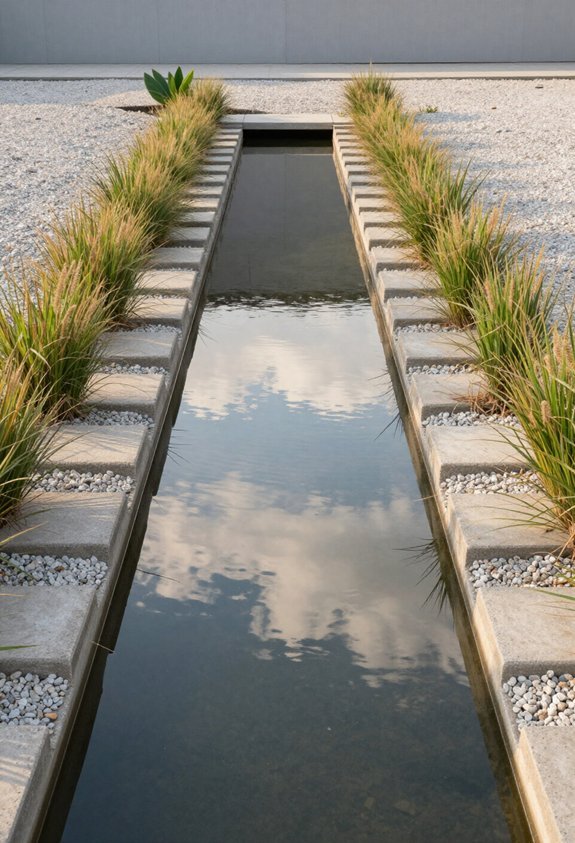
When sound and motion must enter a minimalist front yard without disturbing its visual order, a narrow water channel offers a precise solution, threading a thin ribbon of movement through the disciplined geometry of paved surfaces and planted beds. The channel, typically constructed from concrete, stone, or metal, measures between six and twelve inches in width, sufficient to carry a shallow, continuous flow of water that produces a gentle, audible murmur without visual bulk. Positioned to bisect the yard or trace a path alongside the primary walkway, it creates a linear element that reinforces rather than interrupts the overall composition. Recirculating pumps maintain water flow with minimal energy use, while integrated grating prevents debris accumulation. Lighting placed beneath the water surface transforms the channel into a luminous strip after dark, extending its function across temporal boundaries without adding physical complexity.
Plant One Sculptural Tree as Focal Point
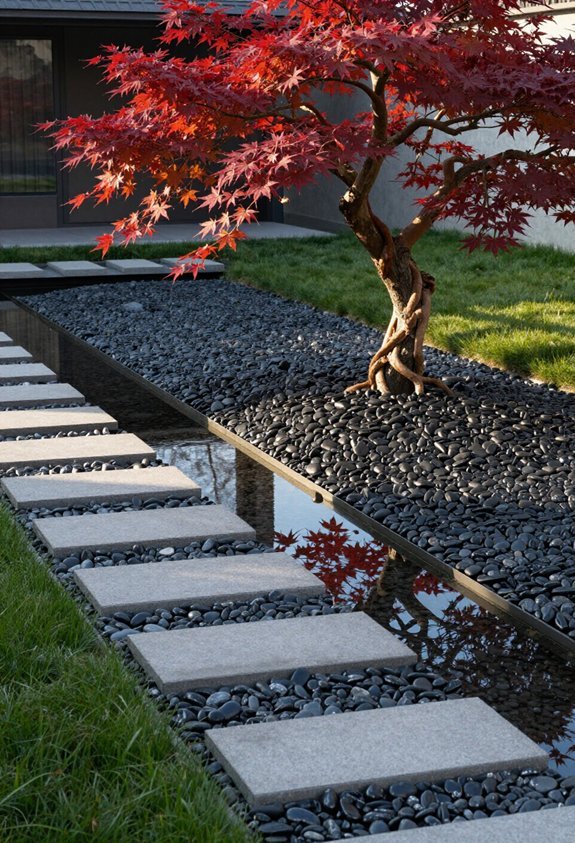
Water channels introduce movement without clutter, yet a living element can anchor the entire space with equal restraint. A single sculptural tree functions as the primary focal point, drawing the eye without overwhelming the composition. Species selection demands careful consideration of form, scale, and seasonal behavior. Japanese maple, olive, or multi-stem birch offer distinctive silhouettes that maintain visual interest year-round through branching structure, bark texture, or foliage color. Placement follows principles of balance and proportion, typically positioned off-center to create dynamic tension against horizontal surfaces. The surrounding ground plane remains largely unplanted, using gravel, stone, or uniform groundcover to emphasize the tree’s isolation. Maintenance requirements stay minimal when mature specimens are chosen for appropriate climate conditions. Pruning preserves architectural clarity, removing competing leaders and interior congestion. This approach reduces visual complexity while establishing hierarchy, allowing the tree to function as living sculpture within the restrained spatial framework.
Install Low Horizontal Fencing for Boundaries
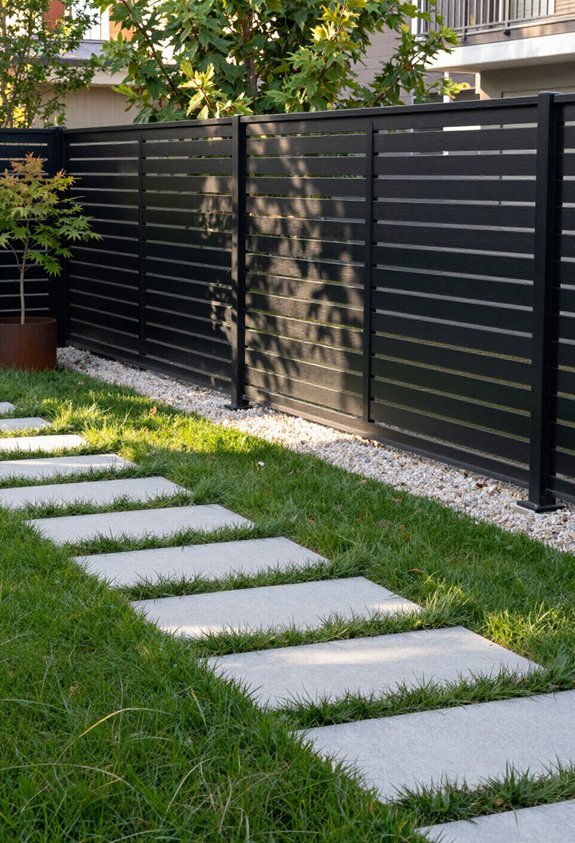
Three distinct functions emerge when low horizontal fencing defines property edges: spatial enclosure, visual continuity, and deliberate connection to the surrounding landscape. The reduced height maintains sightlines across neighboring properties, preventing visual obstruction while establishing clear territorial markers. Horizontal slats, spaced with deliberate gaps or positioned in solid sequence, direct the eye along the property line rather than upward, emphasizing the yard’s planar dimensions.
Materials selection shapes both aesthetic and functional outcomes. Cedar and redwood offer natural weathering patterns, while composite materials provide uniform color retention with minimal maintenance requirements. The fence base typically sits four to six inches above grade, allowing airflow and preventing moisture accumulation at ground contact points. Installation requires precise post spacing, usually six to eight feet on center, with horizontal rails secured through concealed fasteners to preserve clean surface planes. Grading adjustments accommodate slope variations without stepping, maintaining consistent top edges that reinforce the minimalist intent.
Use Corten Steel for Architectural Edging
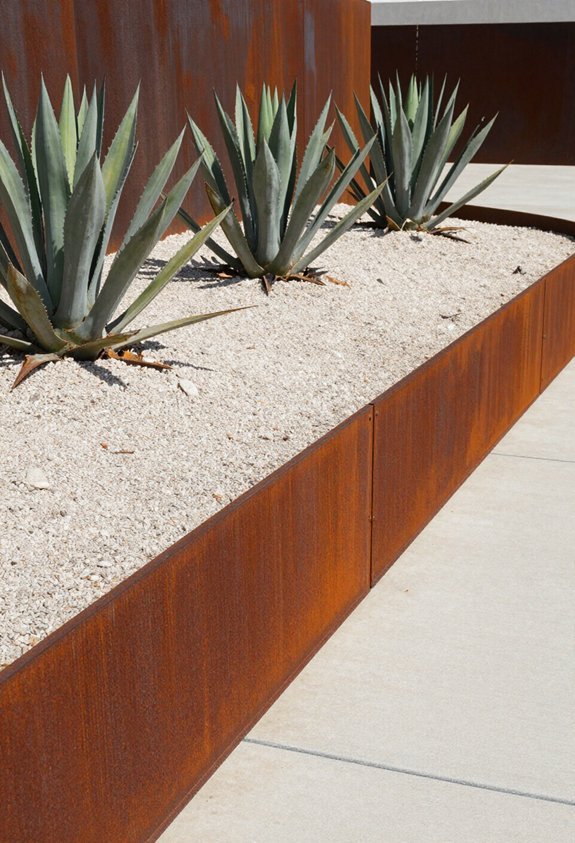
Corten steel introduces a weathered, industrial aesthetic that defines garden beds, pathways, and lawn boundaries with crisp geometric precision. The material develops a stable rust-like patina over time, eliminating the need for paint or sealants while resisting further corrosion. Its thin profile allows for seamless shifts between surfaces, creating visual continuity without bulk. Installation involves driving sections into soil at consistent depths, ensuring level alignment along straight runs or gentle curves. The steel’s warm orange-brown tones contrast effectively with gravel, concrete, and plantings. Edging heights typically range from four to eight inches, containing mulch and preventing grass encroachment. Joints between sections require minimal overlap, producing nearly invisible connections. This approach suits drought-tolerant landscapes and modern architectural contexts, where material honesty and low maintenance remain priorities.
Design a Contemporary Courtyard Enclosure
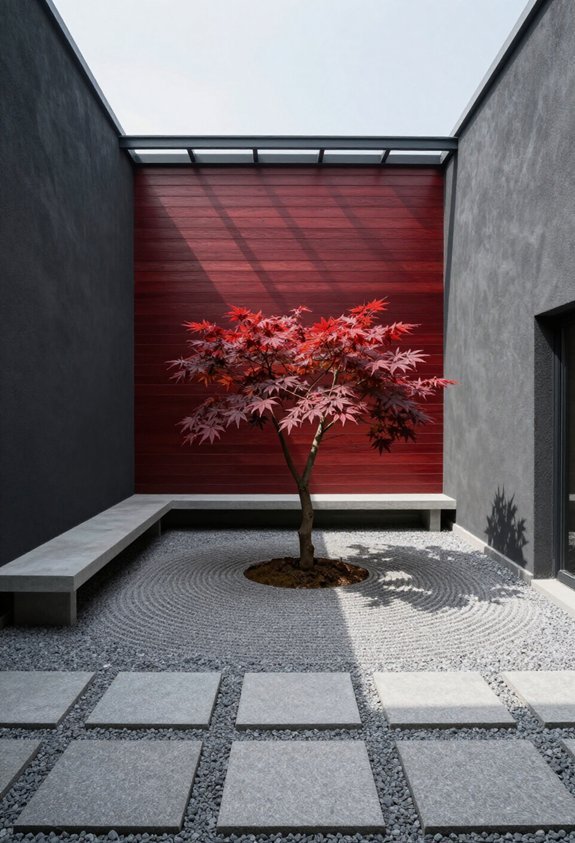
While Corten steel defines edges and boundaries at ground level, enclosing a courtyard demands vertical elements that shape space and control views without overwhelming the minimalist intent. Tall, narrow panels of weathered steel or smooth concrete create partial screens that filter sightlines while allowing air and light to pass through. These vertical planes stand at calculated intervals, establishing rhythm and defining the courtyard’s perimeter without solid walls that would isolate the space entirely. Horizontal slats of aluminum or timber offer another approach, their gaps creating shifting patterns of shadow and transparency throughout the day. The height of these elements typically ranges from six to eight feet, sufficient for privacy yet low enough to maintain connection with surrounding architecture. Placement follows geometric logic, often aligning with existing structural grids or doorways to extend the home’s interior order outward into the landscape.
Light Your Paths With Recessed Linear Fixtures
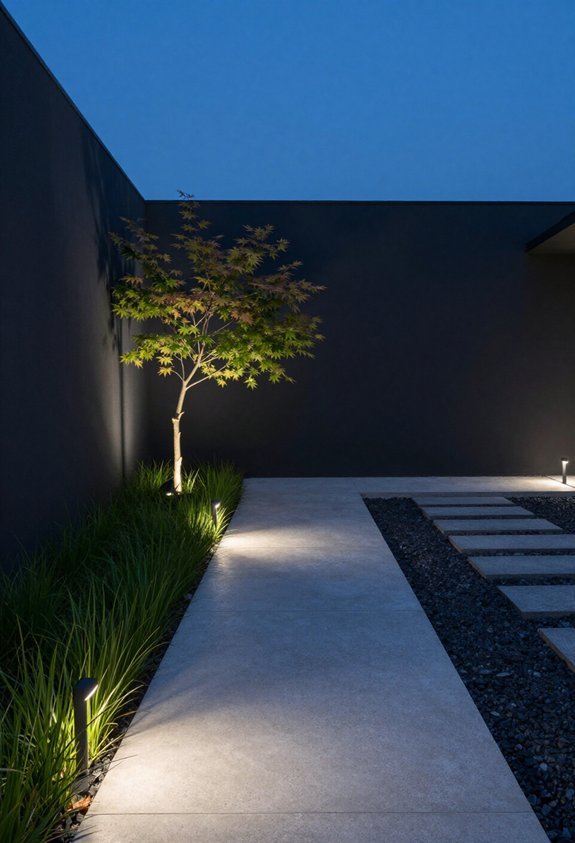
Several lighting approaches exist for minimalist front yards, yet recessed linear fixtures distinguish themselves through their capacity to merge completely with hardscape surfaces. These slim channels install flush with concrete, stone, or paver pathways, eliminating visual interruption while casting uniform pools of illumination across walking surfaces. Designers typically position fixtures along path edges or in geometric patterns that echo the yard’s linear composition. LED strips housed within weatherproof aluminum extrusions provide longevity and energy efficiency, with color temperatures between 2700K and 3000K offering warm, welcoming light. Spacing intervals of four to six feet guarantee continuous coverage without excessive brightness. Photocell sensors or timers automate operation, reducing maintenance demands. The absence of protruding elements protects fixtures from damage during snow removal or landscaping activities, preserving the clean aesthetic essential to minimalist design principles.
Stack Natural Stone in Terraced Walls
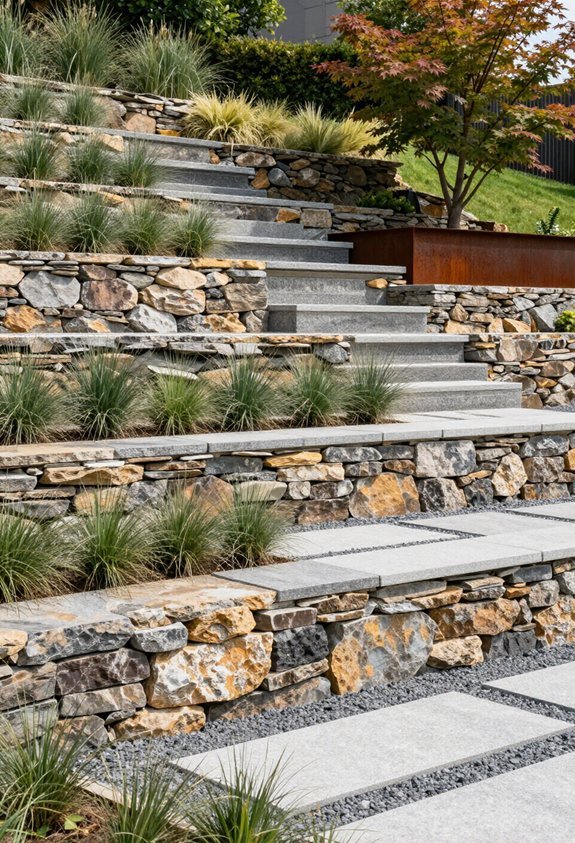
Stack natural stone in horizontal layers to create terraced walls that tame slopes while preserving the restrained aesthetic central to minimalist design. Each tier forms a distinct level, transforming uneven terrain into flat, usable planes that guide the eye horizontally rather than vertically. The stones, selected for uniform thickness and muted coloration, stack without mortar in some applications, allowing subtle gaps that emphasize precision. Builders align joints between tiers with mathematical regularity, ensuring no element appears haphazard. Drainage requires consideration, with gravel backfill and weep holes preventing water pressure buildup behind each wall. The terracing creates planting beds whose edges are defined by the stone itself, eliminating need for additional borders. Materials such as limestone, sandstone, or granite offer durability while weathering to soft, neutral tones that complement surrounding architecture.
Group Identical Pots in Ordered Rows
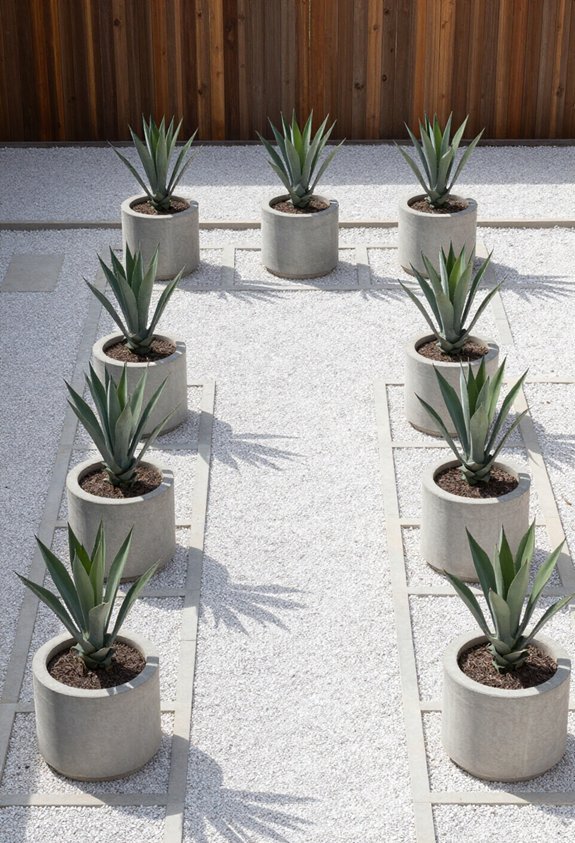
Arrange a series of matching containers in linear formations to establish visual rhythm and reinforce the disciplined structure inherent to minimalist landscapes. Select cylindrical, cubic, or rectangular vessels in unifying materials such as terracotta, concrete, or matte ceramic, ensuring identical dimensions and finishes throughout the arrangement. Position containers along pathways, driveways, or property boundaries with measured spacing, typically maintaining equal intervals between each unit to create predictable patterns that guide the eye forward.
Plant uniform specimens within each vessel, such as single ornamental grasses, compact boxwood spheres, or architectural succulents, thereby extending the principle of repetition from container to contents. This method eliminates visual competition, directing focus toward the geometric precision of the overall composition. For enhanced impact, align multiple rows in parallel configurations, varying elevation slightly while preserving horizontal continuity across the yard’s surface.
Slope Your Yard in Even Terraced Levels
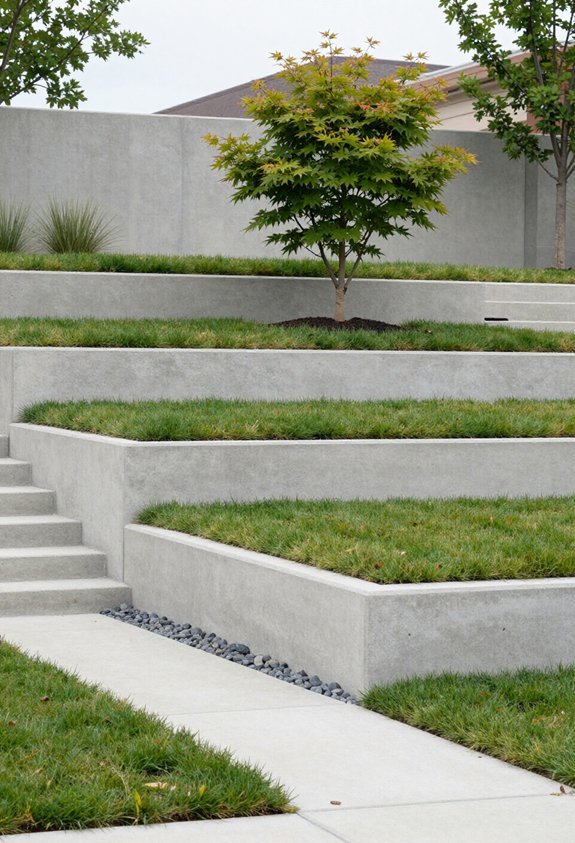
When a yard sits on an incline, transforming that slope into a series of flat, evenly spaced terraces creates both visual order and practical usable space within a minimalist framework. The process begins with surveying the existing grade to determine how many levels the terrain will support, typically between three and five for residential applications. Each terrace requires a retaining structure, constructed from concrete, steel, or timber, selected for durability and visual consistency with surrounding materials. The height between levels must remain uniform, generally eighteen to twenty-four inches, to establish rhythm and simplify maintenance access. Drainage systems integrate beneath each surface, directing water downward through concealed channels rather than allowing erosion across exposed soil. The horizontal planes themselves receive uniform treatment: gravel, poured concrete, or closely cropped ground cover, eliminating visual interruption. Planting, when present, remains restrained and linear, confined to designated borders that emphasize the horizontal layering rather than competing with it.
Choose Bold Silhouette Plants for Structure
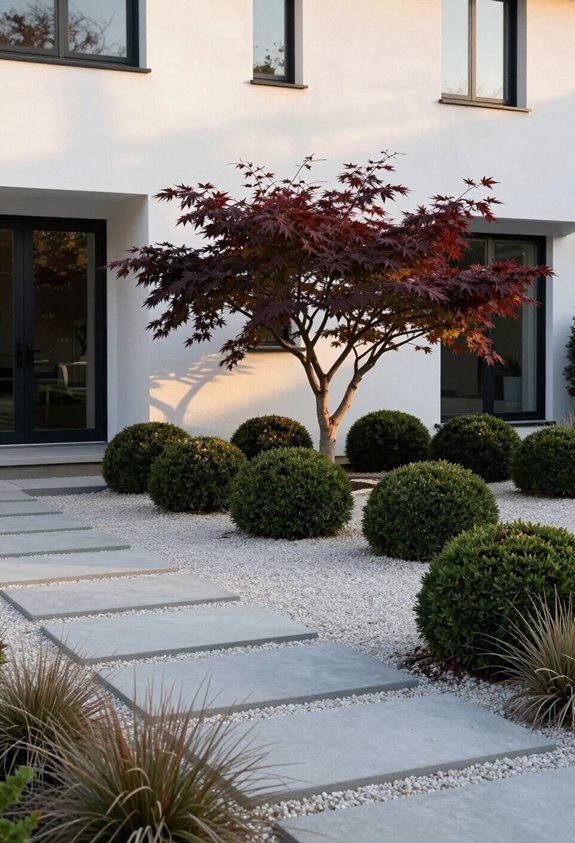
Terraced levels establish horizontality through built elements, yet a minimalist front yard also requires vertical definition that living materials alone can provide. Bold silhouette plants supply this structural necessity through their distinctive, clean outlines against open space. Specimens such as yucca, agave, or columnar junipers present geometric forms that echo architectural lines without visual clutter. These plants function as living sculptures, their shapes remaining legible from multiple angles throughout seasonal changes. Selection prioritizes varieties with consistent profiles, avoiding species with irregular branching or excessive fine texture. Placement follows deliberate spacing, typically as isolated focal points or evenly distributed anchors along sightlines. Scale demands careful calibration: oversized specimens overwhelm minimalist compositions, while undersized choices fail to register against hardscape masses. Maintenance requirements remain minimal, as these structural plants often tolerate drought and resist pests, preserving their crisp silhouettes with limited intervention. Color palettes stay restrained, emphasizing silvery greens, deep blues, or achromatic tones that integrate seamlessly with concrete, stone, or gravel surfaces. The result achieves spatial rhythm through calculated vertical accents that punctuate horizontal planes without competing for attention.
Integrate Seating Into Hardscape Geometry
26 FALL FRONT YARD DECORATIONS That Feel Festive!
Although built elements establish the foundational structure of a minimalist front yard, seating must be woven directly into this geometric framework rather than added as afterthought furnishings. Built-in benches aligned with retaining walls or perimeter hedges create continuous visual planes that extend the architecture outward, while cantilevered concrete slabs emerging from raised planters offer perch points without interrupting sightlines. Recessed seating niches carved into boundary walls maximize usable space in compact areas. The angles of integrated seats must mirror those of adjacent paving patterns, whether orthogonal grids or radial arrangements, ensuring cohesion across the entire surface. Joints between seating and walking surfaces disappear when materials match precisely, erasing the distinction between where one stands and where one rests.
Limit Materials to Two Complementary Tones
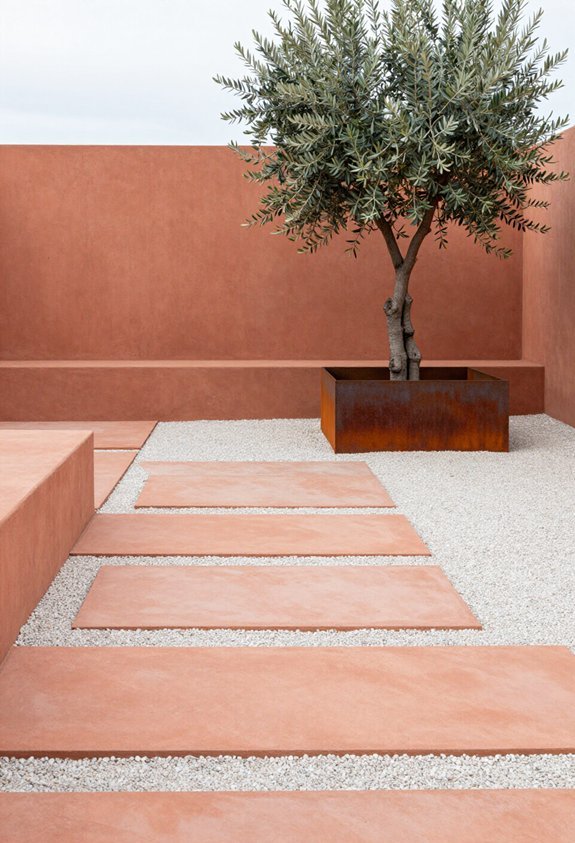
Every successful minimalist front yard relies on strict material discipline, and limiting the palette to two complementary tones establishes the visual restraint that defines this design approach. When designers select materials, they typically pair a warm neutral, such as buff limestone or caramel wood, with a cool neutral, like charcoal concrete or slate gray metal, creating subtle contrast without visual chaos. This binary system eliminates the patchwork effect that occurs when multiple colors compete for attention across small spaces.
The application extends across all surfaces: paving, fencing, planters, and architectural elements adhere to this dual-tone rule. For example, pale gravel might rest against dark steel edging, or bleached cedar cladding might frame black-framed windows. Repeating these two tones throughout the yard unifies the composition, allowing texture and proportion to assume greater importance than color variation.
Let Negative Space Do the Heavy Lifting
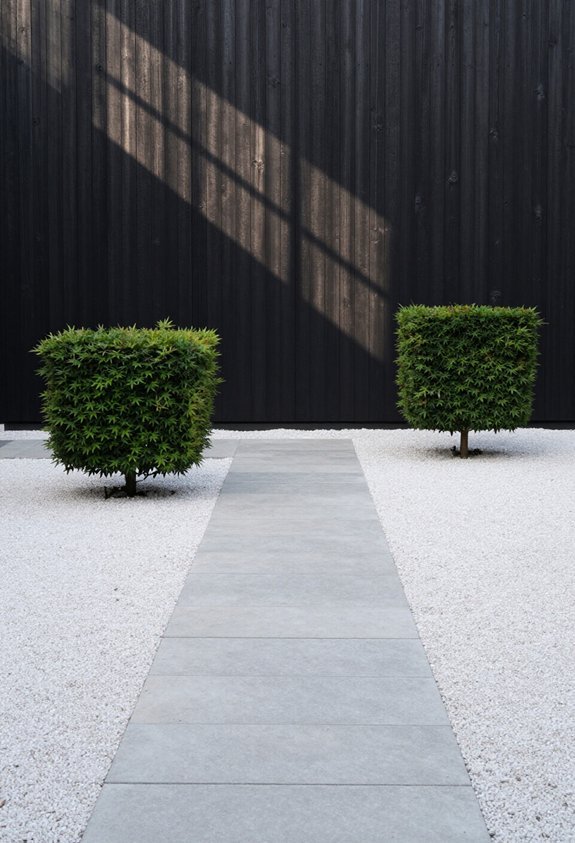
Because minimalist design strips away nonessential elements, the areas left untouched carry as much visual weight as the features themselves, requiring careful planning to guarantee that open ground, empty wall surfaces, and uncluttered sightlines function as intentional components rather than accidental absences. In practice, this means leaving generous gaps between plantings, allowing pavement to extend without objects breaking its plane, and resisting the impulse to fill every corner with decoration. The eye travels faster through open areas, creating rhythm and rest that busy compositions cannot achieve. A single sculptural element placed within ample void draws focus more effectively than crowded arrangements. Designers calculate proportions carefully, ensuring that hardscape and softscape exist in deliberate tension. Shadows cast across empty surfaces become part of the composition, shifting throughout the day. Maintenance demands decrease when less occupies the field of vision.
Frequently Asked Questions
How Much Does Minimalist Landscaping Increase Home Value?
Minimalist landscaping typically increases home value by 5-15%, with precise returns varying by market conditions, design quality, and property location. Clean, low-maintenance outdoor spaces appeal broadly to prospective buyers seeking contemporary aesthetics and reduced upkeep demands.
Do Minimalist Yards Require Less Maintenance Than Traditional Gardens?
Minimalist yards generally require less maintenance than traditional gardens. Reduced plant variety, simplified hardscaping, and minimal lawn area decrease watering, pruning, and weeding demands. Fewer elements mean less time spent on upkeep overall.
Which Climates Suit Minimalist Front Yard Designs Best?
Arid and Mediterranean climates suit minimalist front yards best, as drought-tolerant plants, gravel, and hardscaping thrive naturally there. Temperate regions also work well. Humid tropical areas present challenges, requiring careful plant selection to maintain clean, uncluttered aesthetics.
How Do I Prevent Gravel From Spreading Onto Walkways?
Edging materials contain loose gravel effectively. Metal, stone, or concrete borders create physical barriers. Slightly recessed walkways or raised edging strips prevent migration. Regular raking maintenance also controls displacement. Proper installation angle directs water flow appropriately.
Can Minimalist Design Work With Historic Home Architecture?
Compatibility between minimalist design and historic architecture depends on execution. Clean lines complement period details when materials echo original craftsmanship. Restraint matters; stripping ornamentation entirely risks disharmony. Selective simplification preserves character while achieving contemporary clarity.
Conclusion
Minimalist front yard design relies upon deliberate restraint, where every element serves a clear purpose without excess ornamentation. By implementing clean pathways, structured gravel, geometric planters, and two-tone material palettes, homeowners establish visual order and tranquility. Negative space functions as an active design component, allowing bold plant silhouettes and hardscape geometry to command full attention. The result produces a serene, low-maintenance landscape that emphasizes clarity, intentionality, and timeless sophistication through subtraction rather than accumulation.