

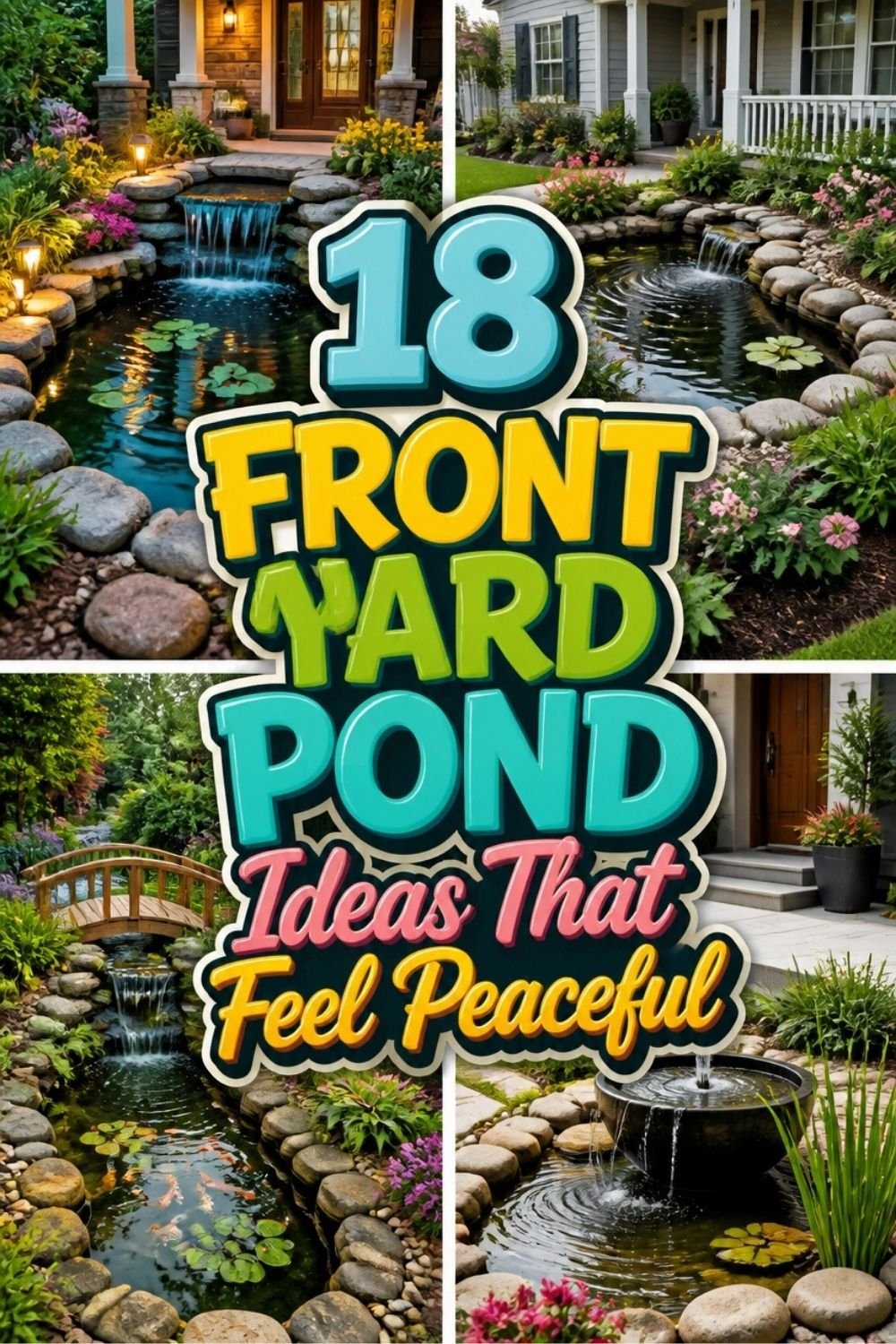
A front yard pond transforms outdoor space through deliberate water placement and ecosystem integration. Small containers suit beginners, while stock tanks support aquatic life with minimal construction. Strategic positioning near walkways, porches, or driveways creates visual flow between architecture and landscape. Wildlife benefits from native plant selection, and sloped terrain enables kinetic water features. The remaining possibilities address scale, maintenance, and aesthetic cohesion in ways that merit closer examination.
Start Small With a Container Pond
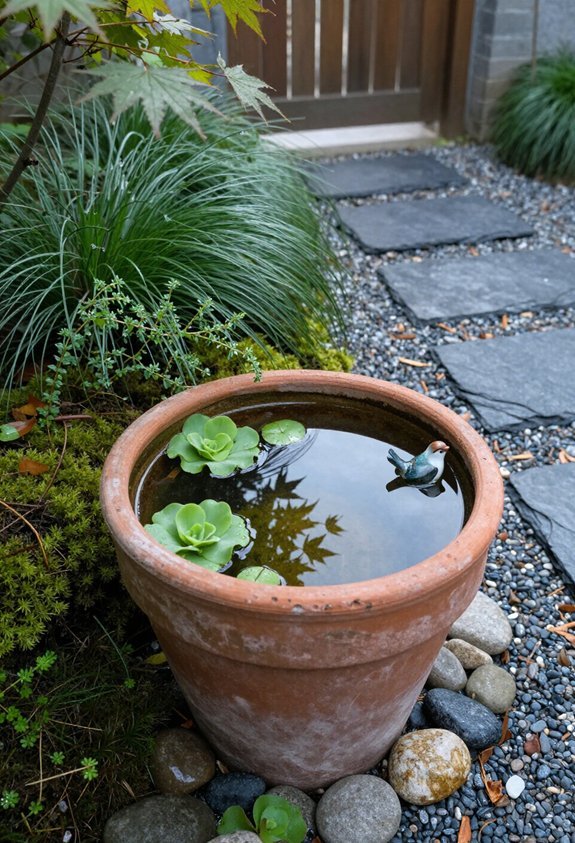
Before committing to an extensive excavation project, gardeners may find that a container pond offers a practical introduction to water features, allowing them to assess maintenance requirements and aesthetic preferences with minimal investment. A galvanized metal trough, ceramic basin, or glazed planter serves as the primary vessel, requiring only a small submersible pump and filtration system to maintain water clarity. Placement demands consideration of sunlight exposure, as four to six hours support aquatic plants without encouraging excessive algae proliferation. Dwarf water lilies, parrot’s feather, and water hyacinth thrive in confined environments, providing surface coverage that limits evaporation and temperature fluctuation. Edging the container with stones, driftwood, or compact ornamental grasses integrates the feature into surrounding landscape elements. Regular monitoring of water levels, debris removal, and seasonal pump maintenance establish foundational skills applicable to larger installations.
Also read: 24 FRONT YARD FLOWER GARDEN Plans That Stay Pretty!
Upgrade to a Stock Tank Front Yard Pond
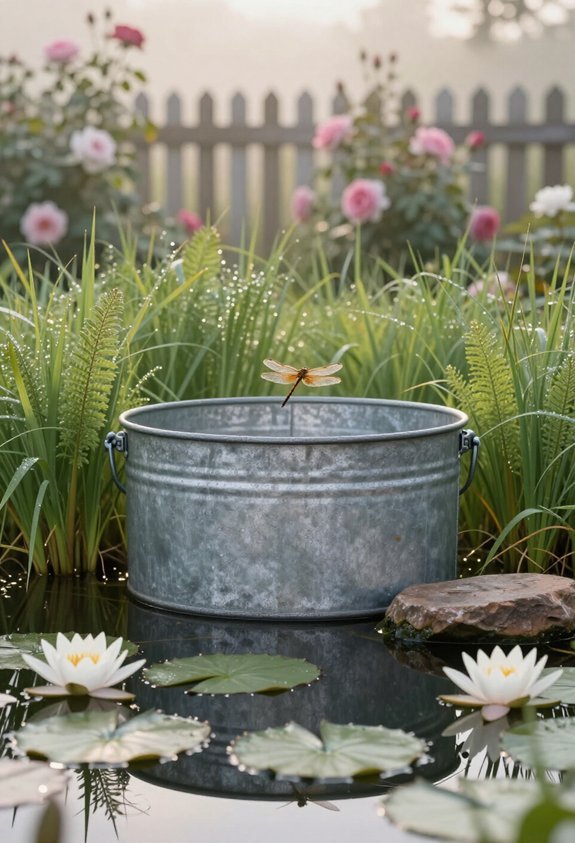
Why limit oneself to modest containers when a galvanized stock tank offers substantially greater capacity for aquatic ecosystems without demanding the labor of permanent excavation? These robust, cylindrical vessels, originally designed for agricultural use, typically range from one hundred to several hundred gallons, providing ample depth for water lilies, small fish, and submerged oxygenating plants.
Placement requires a level, compacted surface capable of supporting substantial weight when filled. Most homeowners position stock tanks as raised features, their metallic walls forming visible structural elements that complement industrial or rustic landscaping themes. Installation involves installing a submersible pump for circulation, adding aquatic soil in mesh baskets for plantings, and incorporating floating vegetation to shade water and reduce algae proliferation. Winter maintenance demands draining and storing portable units or employing stock tank heaters to prevent complete freezing in permanent installations.
Tuck a Pond Beside Your Front Walkway
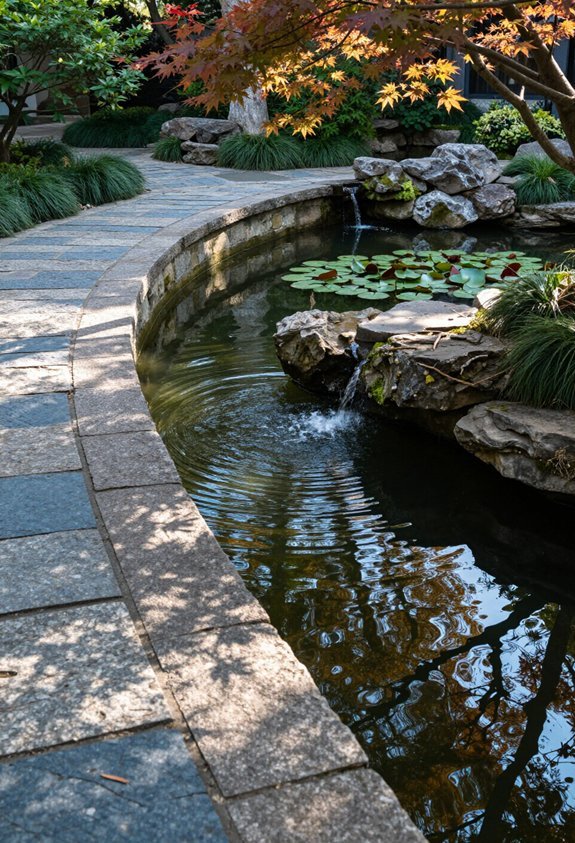
Stock tanks command attention as central features, yet water elements need not dominate a landscape to create meaningful impact. Positioning a compact pond alongside a front walkway introduces gentle sound and reflective surfaces without obstructing traffic flow. This placement leverages existing foot traffic patterns, allowing passersby to glimpse aquatic life and moving water during daily routines. Construction requires excavation proportional to walkway width, typically eighteen to twenty-four inches deep, lined with flexible EPDM rubber or rigid fiberglass shells.
Plant selection favors compact varieties: dwarf cattails, parrot feather, and water lettuce thrive in confined spaces while requiring minimal maintenance. Edge treatments using flat river stone or precast concrete pavers create visual continuity with adjacent hardscape. Submersible pumps rated for three hundred gallons per hour circulate water through simple spout features or bubbler stones, masking ambient street noise with continuous gentle splashing.
Edge Your Porch With a Shallow Water Garden
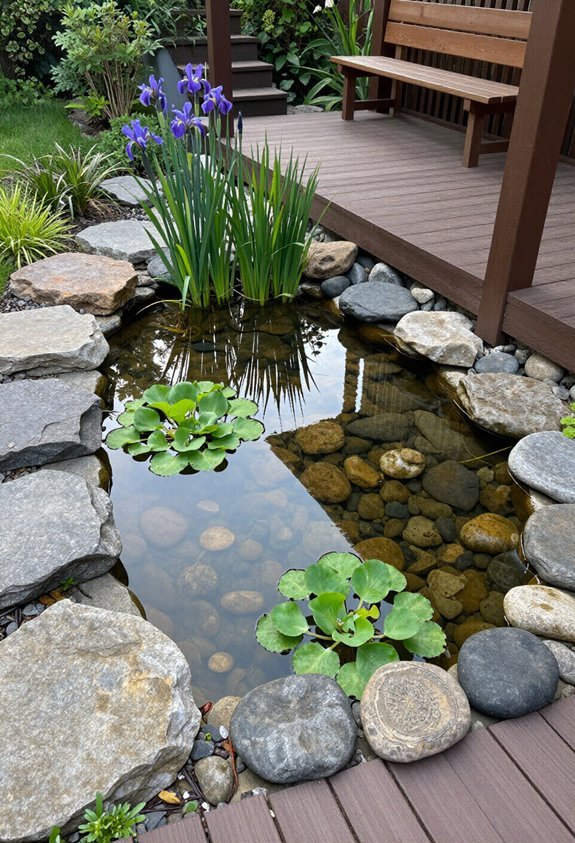
Because porches often serve as intermediary zones between indoor and outdoor spaces, a shallow water garden along their perimeter can soften architectural lines while establishing a cooling microclimate. Depths of four to eight inches accommodate aquatic grasses, dwarf water lilies, and trailing mosses without requiring complex filtration systems. Rigid pond liners or preformed basins simplify installation against existing foundations, while flat stones create stable edging for seating areas. Solar-powered pumps circulate water gently, producing subtle movement that attracts dragonflies and butterflies during daylight hours. Narrow configurations, measuring two to three feet in width, preserve adequate walkway clearance while maintaining visual continuity with lawn areas. Weekly debris removal prevents organic accumulation, and hardy plant selections minimize seasonal maintenance demands. This approach integrates water features into high-traffic zones without compromising functional access or safety considerations.
Frame Your Entry With Matching Pond Basins
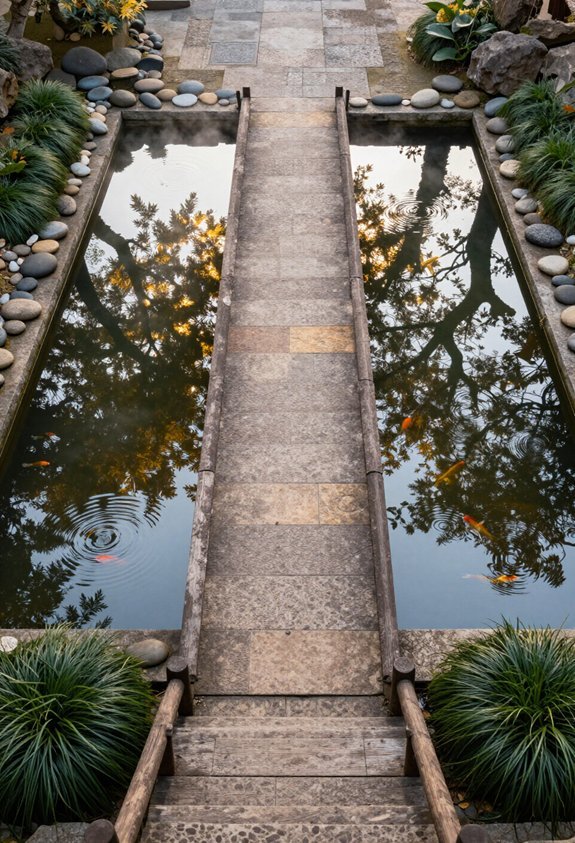
A home’s entrance establishes its visual identity before visitors reach the front door, and symmetrical pond basins flanking the walkway create deliberate architectural emphasis through balanced water elements. These paired installations require identical dimensions, materials, and water depths to maintain visual harmony, typically ranging from two to four feet in diameter with uniform stone or concrete edging. Proper placement positions each basin equidistant from the walkway’s centerline, ensuring proportional spacing relative to the entry’s width. Water circulation systems must match in flow rate and fountain height to prevent visual discrepancy. Plant selection demands identical species in corresponding arrangements, with low-growing aquatic varieties such as dwarf cattails or water lettuce placed at mirrored positions. Lighting fixtures, when incorporated, require synchronized illumination timing and equivalent wattage to preserve nocturnal symmetry.
Build a Disappearing Waterfall (No Pond Required)
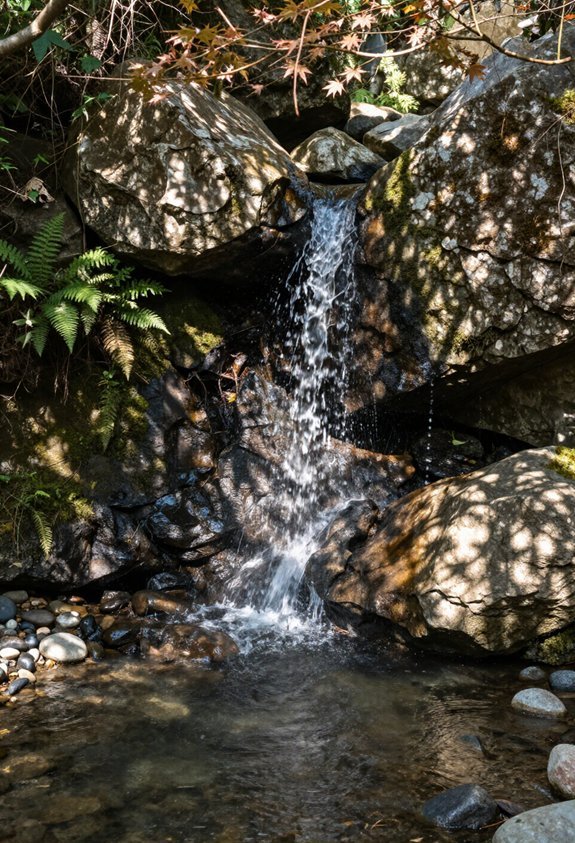
While symmetrical pond basins offer formal elegance through mirrored water elements, disappearing waterfalls provide an alternative approach that eliminates standing water entirely through recirculating design mechanics. This system operates through a concealed reservoir buried beneath decorative gravel, where a submersible pump draws collected water upward through tubing concealed within artificial rock formations. The water cascades over stacked stone surfaces before vanishing into the gravel bed, where it filters through layers of aggregate back into the underground basin for continuous circulation.
Installation requires excavation to accommodate a rigid reservoir basin, placement of a protective grate, and arrangement of pump vaults for equipment access. Surface materials typically include river rock, slate, or fabricated stone selected for texture variation. This configuration reduces maintenance demands associated with algae management, mosquito breeding prevention, and seasonal fish care, while preserving auditory benefits of moving water.
Stack a Tiered Pond for Gentle Water Sounds
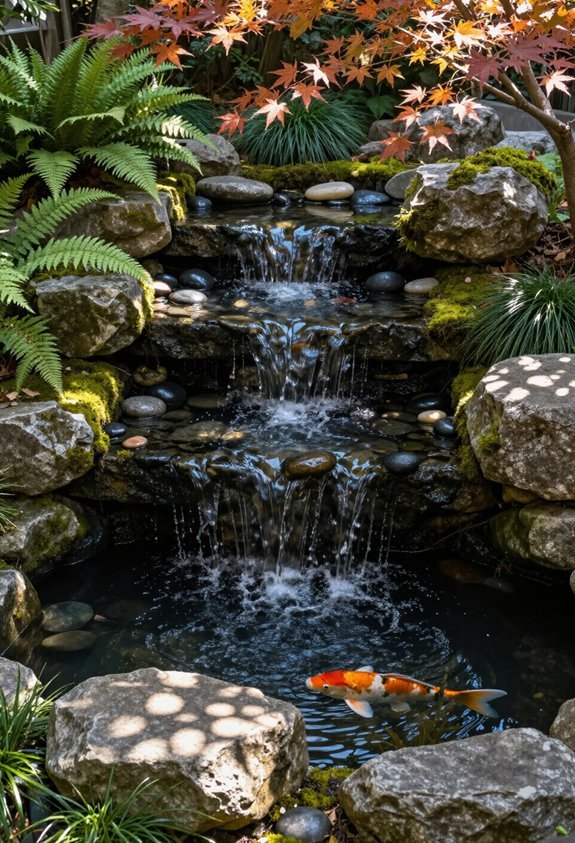
If a gentle, continuous murmur of water suits the intended atmosphere better than silent stillness, a tiered pond arrangement offers an effective solution through graduated elevation changes that break water movement into multiple, smaller cascades. Each level receives water from above and releases it below, creating overlapping sounds that mask individual splashes with blended white noise. Construction requires stacking preformed shells or flexible liners on compacted earth, with each tier set back slightly to prevent erosion and allow visible flow paths. Pump placement in the lowest basin recirculates water continuously. Stone edging conceals liner edges while directing overflow. Plantings between tiers soften connections and filter sediment. Depth decreases at upper levels for safety and structural stability. The result produces predictable, low-volume acoustics without mechanical equipment noise.
Carve Out a Sunken Courtyard Pond
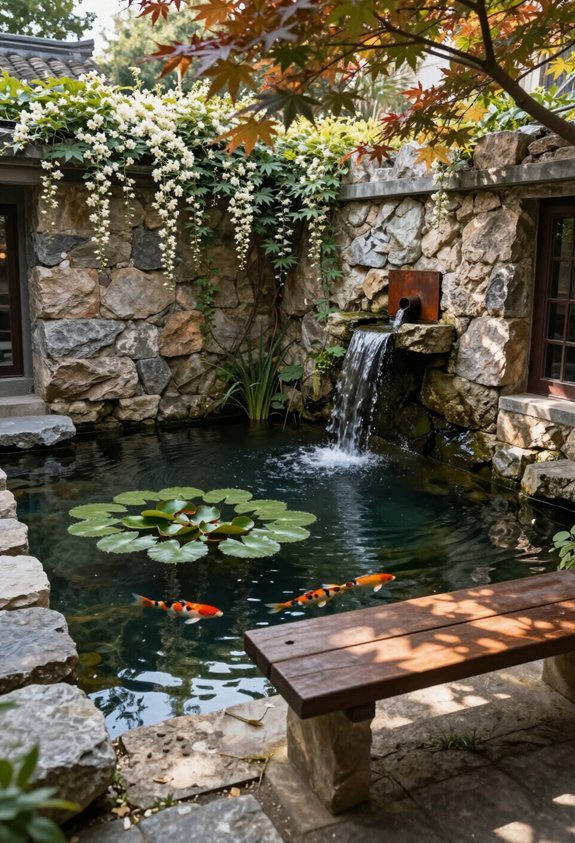
Several design approaches exist for integrating water features into compact front yard spaces, yet sinking a pond below grade level creates distinct spatial advantages by establishing visual privacy and thermal stability through earth-sheltered construction. This technique transforms the front yard by excavating a recessed area, typically two to four feet below the surrounding landscape, which naturally shields the water surface from street-level view and reduces temperature fluctuations.
Constructing retaining walls from stone, concrete, or timber stabilizes the excavated perimeter while forming integrated seating ledges. Drainage requires careful planning through perimeter French drains and submersible pumps to prevent groundwater infiltration. Access demands stairways or sloped pathways with non-slip surfaces. Planting borders at the upper edge softens the vertical shift, while submerged shelves accommodate aquatic vegetation at varying depths.
Shape a Freeform Pond Around Existing Trees
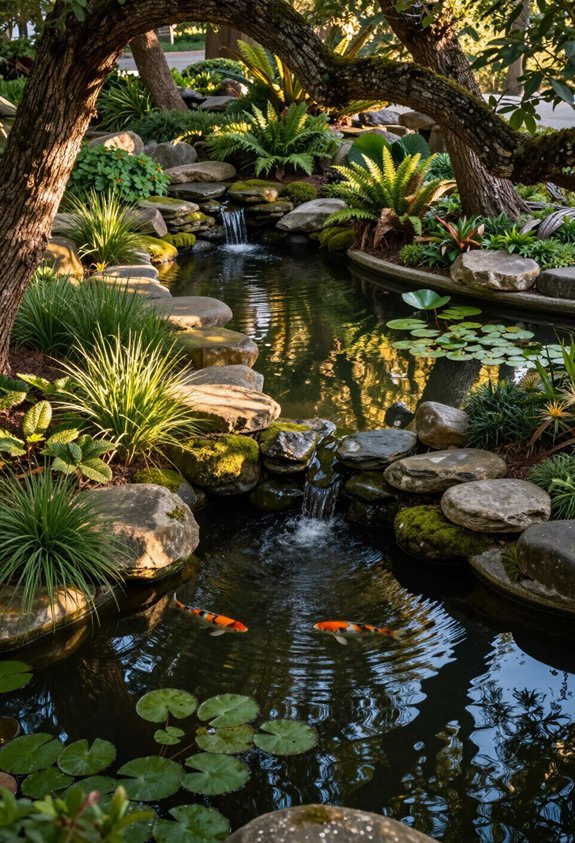
Many homeowners face the challenge of preserving established trees while introducing water features, yet designing a freeform pond that curves around existing root systems offers a practical solution that maintains both ecological health and visual harmony. This approach requires careful mapping of root zones before excavation begins, ensuring that critical anchoring structures remain undisturbed during construction. Flexible rubber or bentonite liners accommodate irregular contours better than rigid prefabricated shells, allowing the water’s edge to meander naturally between trunks and through root flares. Designers typically maintain minimum distances of one foot of undisturbed soil per inch of trunk diameter to prevent compaction damage. Overhanging branches provide beneficial shade that moderates water temperature and reduces algae proliferation. The resulting integration creates established woodland character without waiting decades for new plantings to mature.
Create a Japanese-Inspired Koi Pond
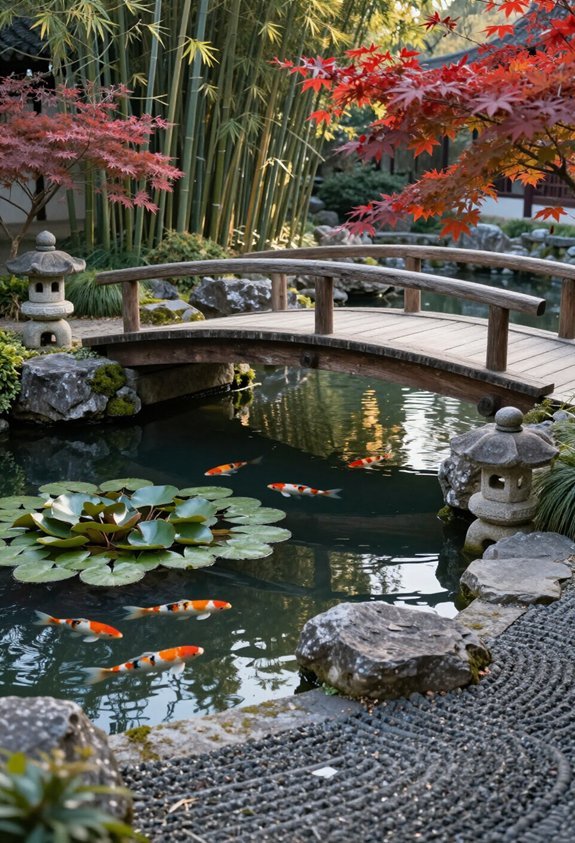
Positioning a Japanese-inspired koi pond in the front yard introduces a structured design philosophy that emphasizes balance between architecture and natural elements, requiring careful attention to proportion, material selection, and ecological functionality. The designer selects irregular, organic shapes that mimic natural water formations, avoiding perfect circles or geometric patterns that disrupt visual harmony. Large, flat stones serve as edging materials, positioned to create accessible viewing areas where observers may contemplate the swimming koi. Waterfalls or streams integrate oxygenation systems essential for fish health, while also producing the gentle sound of moving water. Plantings remain minimal and purposeful, featuring specimens such as Japanese maples, irises, or moss that frame the pond without overwhelming its central presence. Filtration systems remain concealed beneath the surface, preserving aesthetic continuity. The completed installation functions as a meditative focal point, transforming the approach to the residence into a deliberate, calming experience.
Nestle a Pond Into a Rock Garden
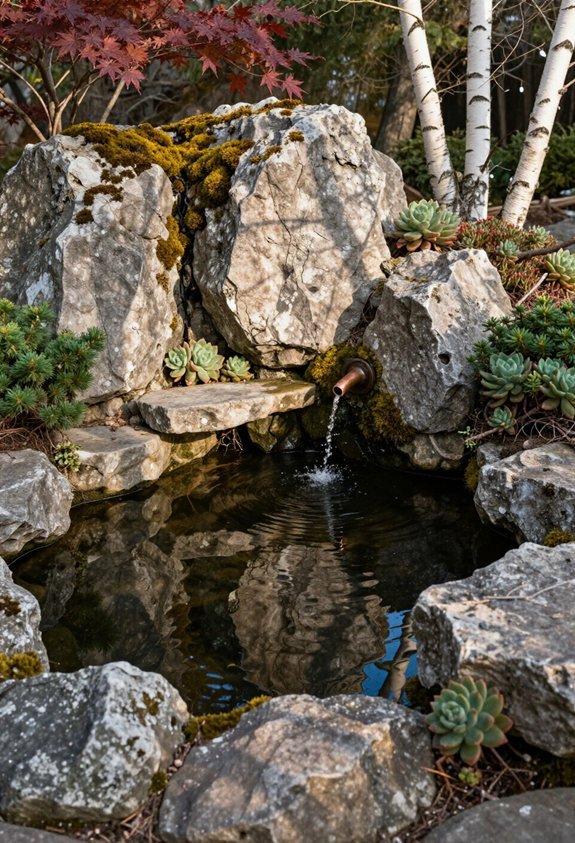
A carefully arranged collection of stones can serve as the foundation for embedding a pond within a rock garden, creating a landscape where water and mineral elements exist in deliberate coexistence. The placement of boulders of varying sizes establishes naturalistic contours that guide water flow and define pond edges without artificial barriers. Smaller stones, including river rocks and gravel, fill intermediate spaces to prevent soil erosion and support drainage systems that maintain water clarity. Alpine plants, such as sedums and saxifrages, occupy crevices between rocks, their shallow root systems stabilizing the stone arrangement while requiring minimal moisture beyond what the pond environment provides. The pond itself functions as a focal point amid the rocky terrain, its surface visible from multiple angles yet partially obscured by strategic stone placement. This integration demands attention to scale, ensuring that water volume remains proportionate to the surrounding rock mass.
Add a Reflecting Pool for Mirror-Calm Water
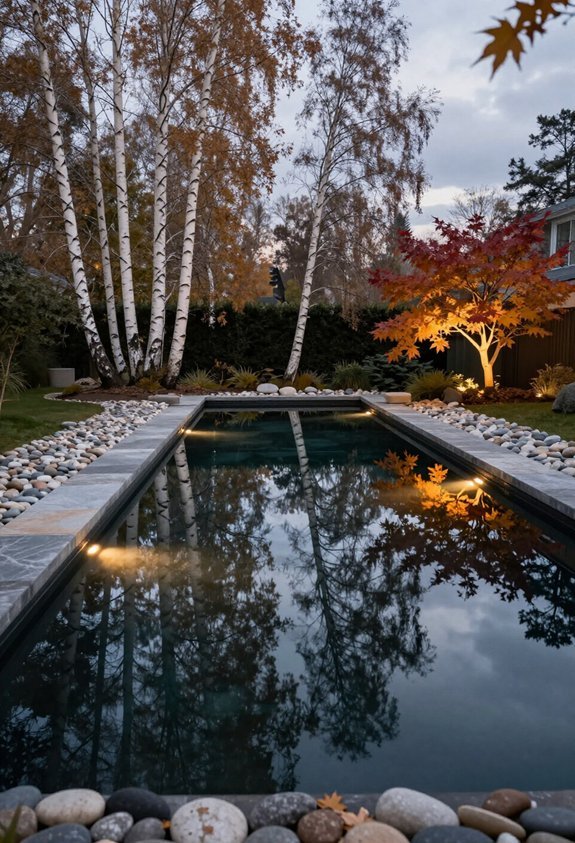
Stillness defines a reflecting pool, its surface engineered to remain undisturbed by jets, cascades, or circulating pumps that would otherwise interrupt the water’s glass-like quality. The installer selects a level site, then excavates a shallow basin with consistent depth, typically six to twelve inches, to prevent thermal layering that might generate subtle currents. A dark liner, often black EPDM or dyed concrete, absorbs light to eliminate surface glare and deepen the mirror effect. Surrounding plantings must sit low and distant from prevailing winds, their placement calculated to buffer air movement across the water. The finished pool captures sky, architecture, and adjacent foliage in precise duplication, creating spatial depth within compact front yards through the mechanism of reflection rather than filtration dynamics or aquatic habitat complexity.
Light Your Pond for Evening Ambiance
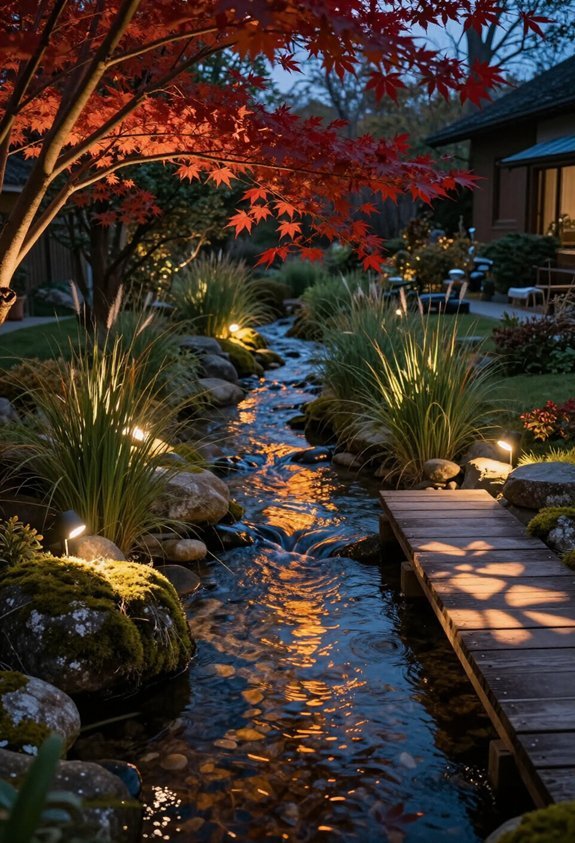
Several strategic lighting placements transform a front yard pond into a visible evening feature, extending its utility beyond daylight hours while establishing controlled illumination that avoids harsh glare or light pollution.
Underwater LED lights create subtle glows from beneath the surface, highlighting fish, plants, and rock formations while maintaining soft diffusion through the water column. Path lighting positioned along pond edges provides safe navigation without overwhelming the aquatic environment. Moonlighting techniques, achieved by placing fixtures high in surrounding trees, cast dappled shadows that mimic natural lunar reflection.
Color temperature selection proves critical, with warm white tones in the 2700-3000 Kelvin range supporting circadian rhythms for wildlife and human occupants alike. Photocell timers automate activation at dusk, ensuring consistent operation without manual intervention. Proper fixture sealing with IP68 ratings prevents moisture infiltration, preserving electrical safety and equipment longevity in submerged conditions.
Install a Solar-Powered Fountain Pond
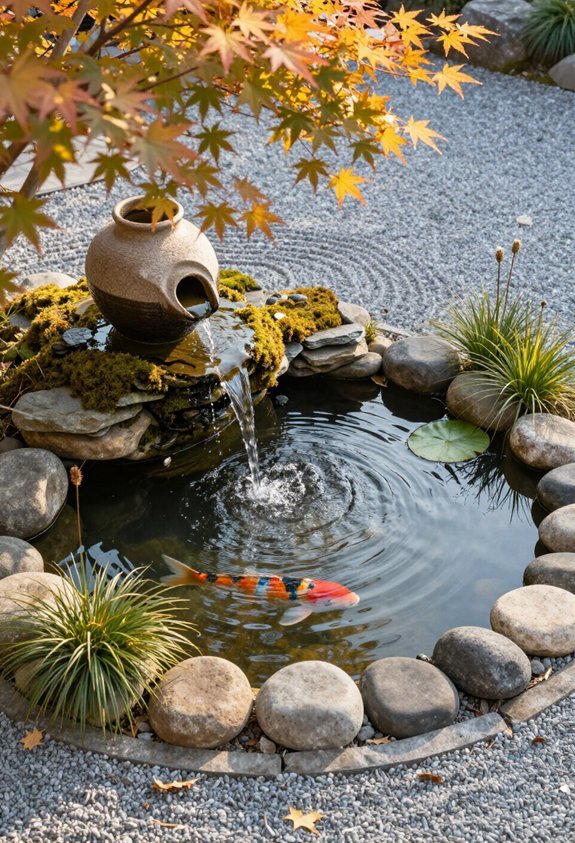
Solar energy offers an accessible entry point for homeowners seeking the auditory and visual benefits of moving water without the complications of buried electrical lines or increased utility costs. A solar-powered fountain pond operates through photovoltaic panels, which convert sunlight into electricity to power submersible pumps that circulate water through decorative spray nozzles or cascading elements.
Installation requires positioning the panel in direct sunlight, angled toward the southern sky for maximum exposure throughout daylight hours. The pump assembly sits within the pond basin, connected to the panel via waterproof cabling that typically spans ten to twenty feet. Flow rates vary from fifty to four hundred gallons per hour, depending on pump specifications and solar panel wattage.
Battery backup systems enable operation during evening hours or overcast conditions, storing excess energy generated during peak sunlight. Maintenance involves periodic cleaning of photovoltaic surfaces and inspection of pump intake filters to prevent debris accumulation that restricts water flow.
Plant Floating Lily Pads for Instant Maturity
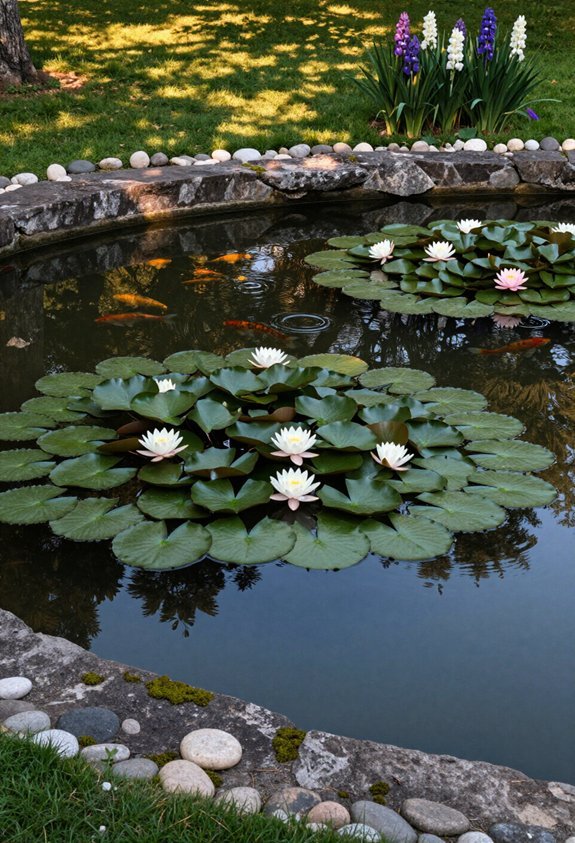
While moving water creates visual interest through ripples and sound, the integration of living plants completes the ecological and aesthetic function of a front yard pond. Floating lily pads offer immediate visual maturity, transforming bare water into established habitat within a single growing season. Hardy water lilies, placed in submerged containers at depths of twelve to eighteen inches, spread circular foliage across the surface, reducing algae growth through shade coverage. The pads create landing platforms for insects and moderate water temperature fluctuations. Gardeners select dwarf varieties for smaller ponds, ensuring proportional scale, while full-sized species suit expansive installations. Blooms emerge seasonally in white, pink, yellow, or red, opening in morning light and closing at dusk. Division every two to three years maintains vigor and prevents overcrowding.
Design a Wildlife-Friendly Native Pond
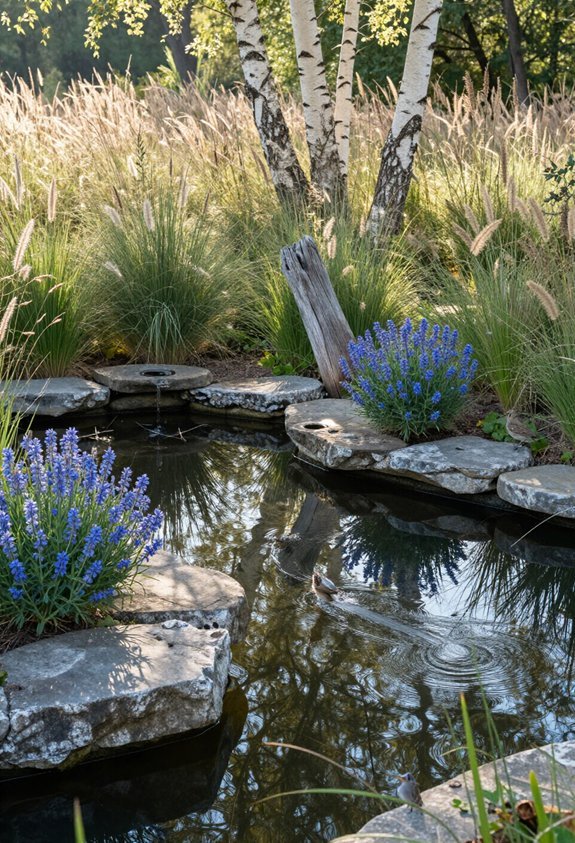
Many front yard ponds serve as isolated water featuresfeatures, yet intentional design choices transform them into thriving ecosystems that support local amphibians, insects, and birds. Native vegetation forms the foundation of this approach, with water-loving water plants, emergent grasses like sedges and rushes, and submerged oxygenators selected from regional species lists rather than ornamental cultivars. Sh
Line Your Driveway With a Narrow Water Rill
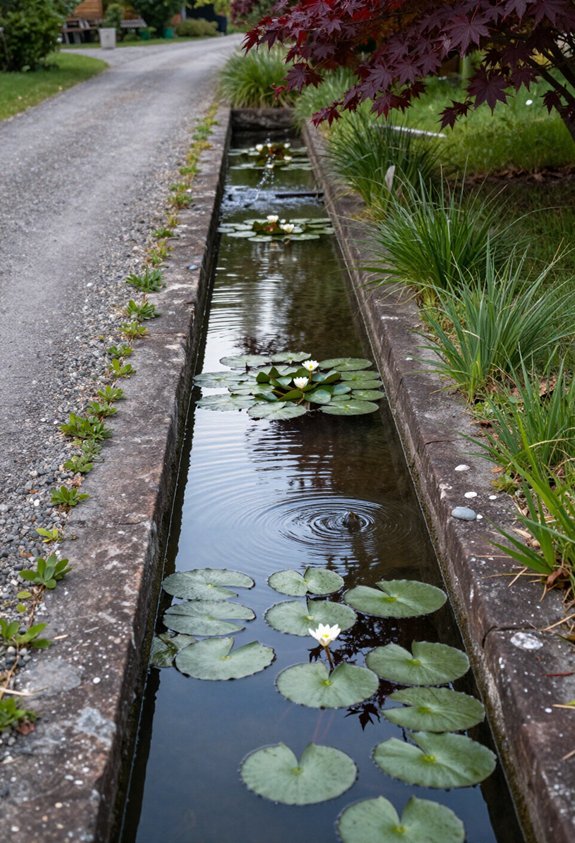
Three primary design elements distinguish a driveway water rill from conventional pond installations: its elongated linear form, the precise containment of water within a narrow channel, and its deliberate placement parallel to vehicular access routes. The rill functions as a geometric water feature that guides movement toward the property entrance while maintaining a modest footprint unsuitable for expansive excavation.
Construction requires a level trench with reinforced sidewalls of stone, concrete, or metal to prevent water loss and soil collapse. A recirculating pump system moves water continuously through the channel, creating a shallow flow that produces audible movement without depth hazards. Maintenance involves periodic debris removal and pump inspection to guarantee unobstructed flow. The narrow profile accommodates limited spaces where traditional ponds prove impractical.
Convert a Front Yard Slope Into a Cascading Stream
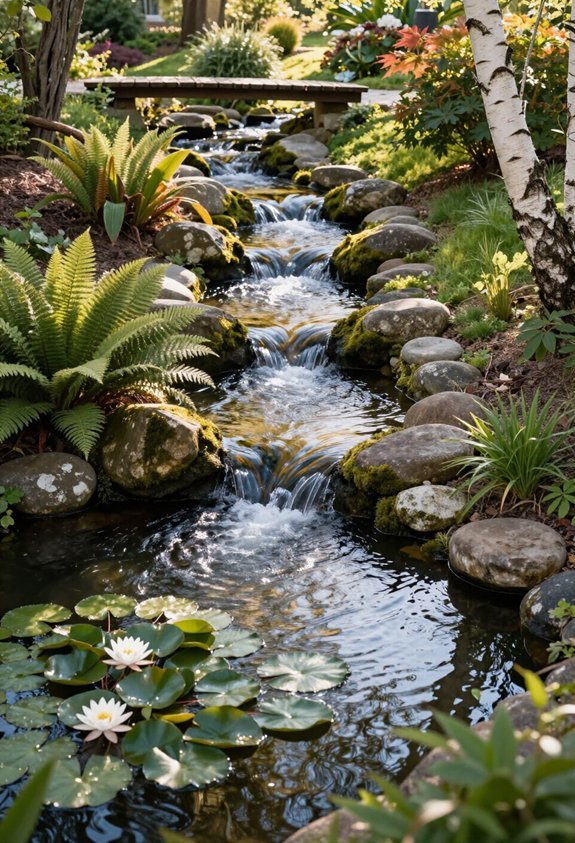
A cascading stream transforms an inclined front yard into a dynamic water feature that mimics natural topography while solving drainage challenges inherent to sloped terrain. The design requires careful grading to create a series of shallow pools connected by small waterfalls that follow the natural descent of the land. Builders install a recirculating pump at the base to move water continuously upward through concealed tubing, establishing closed-loop circulation that conserves resources. Rocks of varying sizes anchor the stream edges, preventing soil erosion while providing structural definition and visual texture. Native moisture-loving plants, such as ferns and sedges, soften the hardscape and establish ecological integration with surrounding vegetation. The resulting installation reduces stormwater runoff velocity, filters impurities through biological processes, and generates gentle acoustic properties that mask urban noise without disrupting neighborhood tranquility.
Frequently Asked Questions
Do Front Yard Ponds Increase Home Insurance Rates?
Front yard ponds may increase home insurance rates due to liability risks and property damage potential. Insurers often classify them as attractive nuisances or water features requiring additional coverage. Rate impacts vary by provider, depth, and local regulations.
How Deep Must a Pond Be to Prevent Mosquito Breeding?
Mosquito prevention requires water movement or depth exceeding two feet with steep sides. Stagnant shallow areas permit egg laying. Aeration systems, fish introduction, or biological controls further eliminate breeding conditions regardless of depth measurements.
Are Permits Required for Small Residential Front Yard Ponds?
Permits vary by jurisdiction, water depth, and proximity to property lines or wetlands. Most municipalities require permits for ponds exceeding specific depths or volumes. Homeowners should consult local zoning offices and environmental agencies before excavating.
Can Pond Water Damage Nearby Home Foundations Over Time?
Water accumulation near foundations risks structural damage through soil expansion, hydrostatic pressure, and moisture seepage. Proper drainage systems, adequate set-back distances, and waterproof membranes mitigate these risks considerably when ponds are installed.
How Do I Keep Neighbors’ Children Safe From My Pond?
Install a four-foot fence with self-latching gates around the perimeter. Add rigid mesh covers or safety grates over the water. Post visible warning signs. Remove accessible ladders or steps. Maintain clear sightlines from the street.
Conclusion
Creating a peaceful front yard pond involves selecting appropriate designs that match available space, slope conditions, and maintenance capacity while integrating water features that support local ecosystems. Whether implementing container ponds, stock tanks, or cascading streams, each option provides distinct acoustic and visual benefits through careful placement of native vegetation, hardscaping elements, and water circulation systems. Successful installation requires evaluating soil drainage, sunlight exposure, and regional climate patterns to guarantee long-term functionality and ecological balance.