

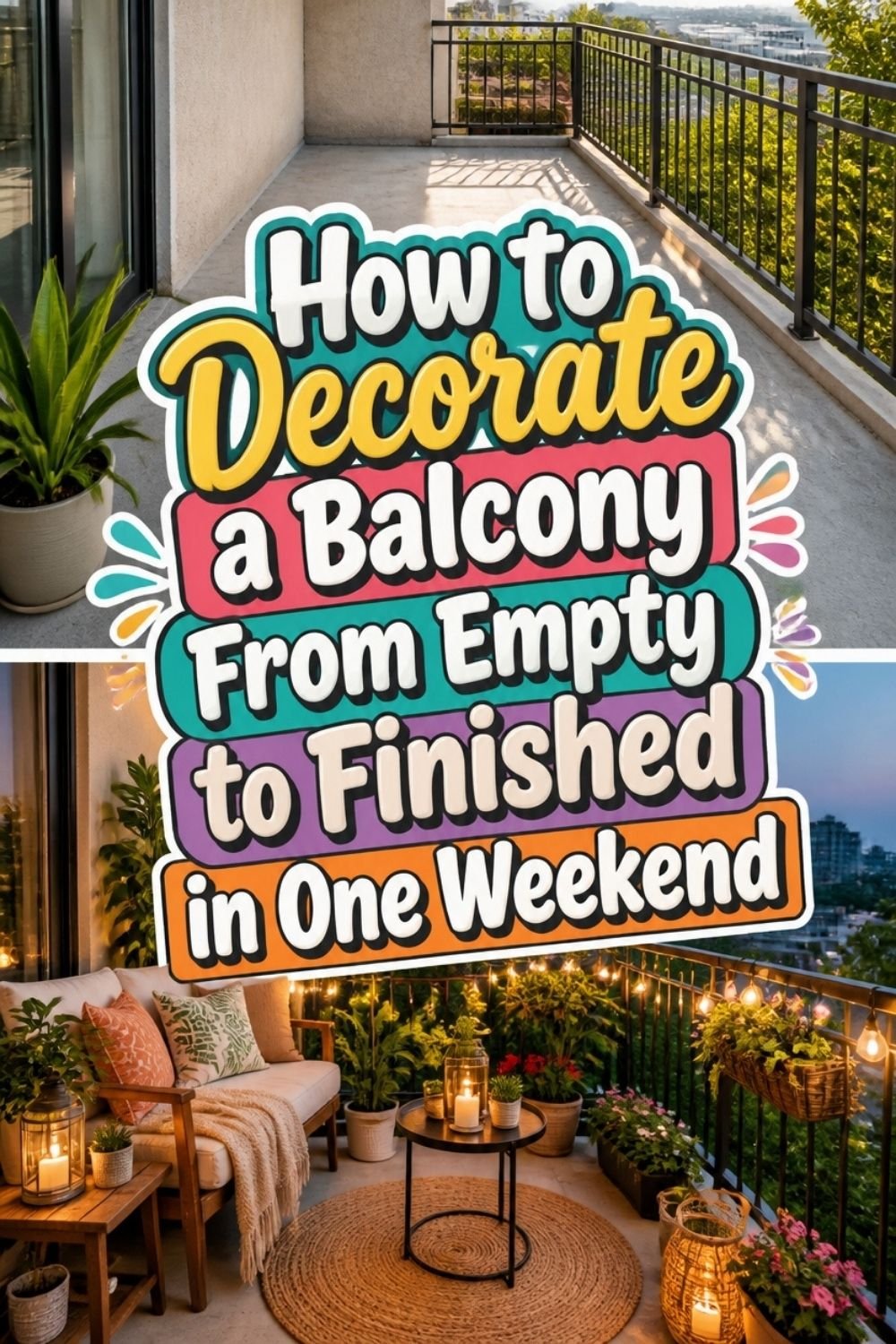
A balcony is not a small patio. It comes with four rules a patio never has: wind that will take your cushions over the rail, a floor with a weight limit, water that drains onto somebody else’s laundry, and a lease that probably forbids drilling into anything.
Most guides on how to decorate a balcony skip all four and show you a styled apartment in a magazine. Then you buy a tall planter, hang it on the outside of the rail because that is what the photo did, and spend the rest of the summer worrying about it.
Those four constraints are not problems to solve at the end. They are the brief. Read them first and you stop buying things you have to return. Everything in this guide is free-standing, hangs without hardware, or sits on the floor.
The work splits across a weekend. Saturday morning is free and involves no shopping at all, just checking your lease, testing the wind, and measuring what you actually have. Saturday afternoon puts down a floor and gets storage off it. Sunday adds the seat, the plants, and the light.
Plan on two half days of work and one shopping trip in between.
Go out on the balcony and stand there for a minute. Notice how much the air is moving. That matters more than anything you buy.
What You Need
Nothing here needs a drill, a bracket, or a permanent fixing. Buy the left column first, since it decides what the right column can be.
- Tension rod, floor to ceiling if covered
- Railing planter brackets, over-rail type
- Adhesive hooks rated for outdoor use
- Cable ties and garden twine
- Free-standing shelf unit, narrow
- Zip-tie screen panels or reed fencing
- Bungee cords for securing in wind
- Interlocking deck tiles or an outdoor rug
- One folding or narrow chair
- Small side table, folding or wall-hung
- Railing planters with drip trays
- Plants, wind-tolerant varieties
- Potting soil and pot feet
- Battery or plug-in warm lights
- Tape measure, broom, bucket
At a Glance
- Read your lease before you buy anything
- Test the wind at the hour you plan to sit out
- Clear the balcony and check where water drains
- Measure the floor and subtract the door swing
- Lay a floor you can lift out later
- Take the storage off the floor and onto the wall
- Screen one side only, on the windward edge
- Place the seat facing out, not against the rail
- Hang planters on the inside of the railing
- Stack the plants vertically
- Run one warm light at eye level
- Sit in it Sunday evening and fix the one thing wrong
Read your lease before you buy anything

Balcony rules are usually written down somewhere and almost nobody reads them until a letter arrives. Look for four things specifically: whether you can drill or screw into walls and railings, whether anything is allowed to hang on the outside of the rail, whether there is a weight limit stated, and whether screens or awnings need approval.
Rules vary hugely between buildings and countries, so your neighbour’s setup is not evidence that yours is permitted. Ten minutes with the document now saves you unpacking something you have to send back.
Test the wind at the hour you plan to sit out
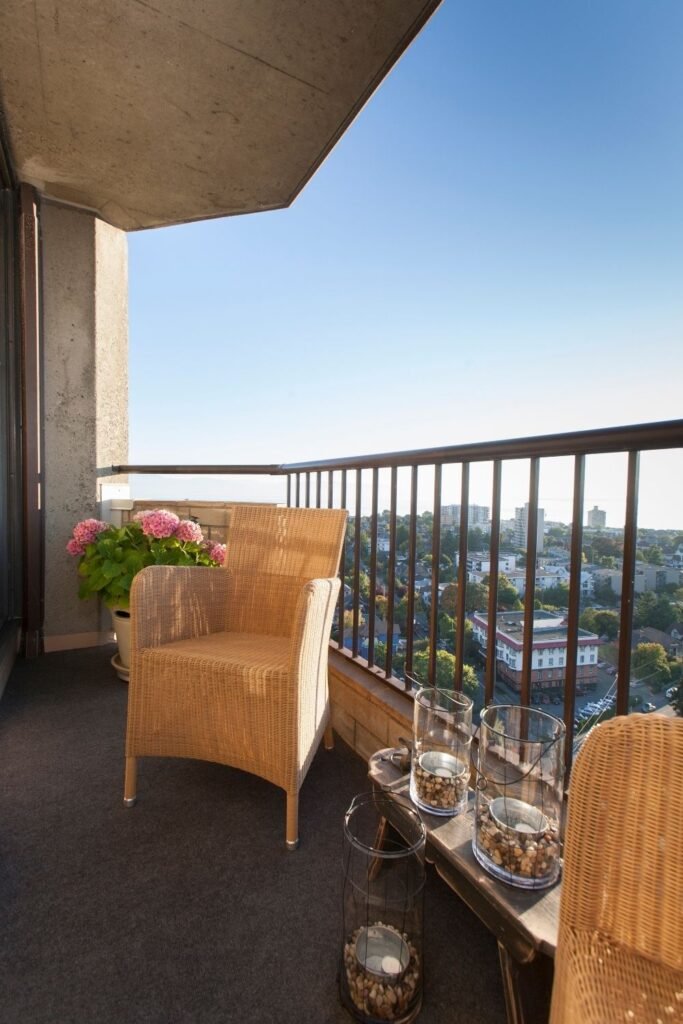
Balconies get far more wind than the ground does, and it gets worse the higher you go. Go outside at the time you would actually use the space, usually early evening, and stand there for five minutes. Notice whether the air is still, moving steadily in one direction, or gusting unpredictably. That answer decides your plants, your screen, and whether cushions need weighting.
Tape a strip of tissue paper or a length of ribbon to your railing and leave it up for a full day. Check it morning, afternoon, and evening. A ribbon that hangs limp most of the day means you can use tall plants and light furniture. One that streams sideways for hours means everything you buy needs weight or a low profile. This also shows you which direction the wind comes from, which is the single fact that decides where your screen goes in Step 7.
Clear the balcony and check where the water drains
Everything comes off, including the bike and the drying rack. Sweep it out, then pour a bucket of water across the floor and watch where it goes. Most balconies drain toward the outer edge or through a small gap at the base of the railing. Some drain toward a corner outlet, and a few barely drain at all.
Knowing this changes what you put down. A rug over a corner drain holds water against the floor. Deck tiles over a slow-draining surface trap it underneath. Find the low point now and keep it clear.
Whatever runs off your balcony lands on the one below. Watering a row of planters without trays is the fastest way to fall out with a neighbour, especially if their laundry is out. Every planter needs a drip tray or a saucer, and you water slowly enough that nothing runs through. Blocking your own drainage is the other risk, since standing water on a balcony floor adds weight, seeps into the structure, and in freezing climates lifts tiles and cracks concrete over a few winters.
Measure the floor and subtract the door swing
Balconies are usually narrower than people guess, and the usable number is smaller still. Measure the full floor, then walk out and mark where the door sweeps, because that arc is dead space no matter how tempting it looks. A typical apartment balcony runs 5 by 8 feet, and the door can eat 9 square feet of that. Write down what is left. Everything you buy has to fit inside that number.
Lay a floor you can lift out later
Renters need a floor that comes up as cleanly as it went down, and that rules out anything glued or nailed. Interlocking deck tiles are the usual answer, since they click together without fixings, lift out in minutes, and raise the surface enough that water still runs underneath. Wood and composite both work outdoors, and composite handles wet climates better.
An outdoor rug is the cheaper route and it does one thing the tiles do not, which is soften the space. It also traps water against the floor, so it needs lifting after heavy rain.
Whichever you pick, keep the drainage point you found in Step 3 clear:
- Leave a 2 inch gap at the drain edge
- Set tiles so the low point stays uncovered
- Keep the rug back from any corner outlet
- Lift and dry the surface every few weeks
Take the storage off the floor and onto the wall
Floor space on a balcony is the whole budget, and anything sitting on it is spending from that budget. Move what you can upward. A narrow free-standing shelf unit against the wall holds tools, watering cans, and small pots while occupying less than 12 inches of depth. Over-rail hooks take a broom or a folded drying rack. What is left on the floor should be furniture and plants only.
A floor-to-ceiling tension rod is the best no-drill fixing available on a covered balcony, and almost nobody uses one outdoors. Wedged between floor and soffit it holds hanging planters, a light string, or a curtain panel with no hardware at all. Check the rod is rated for the full height and keep the load under about 15 pounds. Outdoor-rated adhesive hooks cover the smaller jobs, though they release in heat and need replacing each season, so keep them for light items only.
Screen one side only, on the windward edge
Wrapping the whole railing in reed fencing is the common move and it makes a small balcony feel like a crate. Screen the side your ribbon test pointed at in Step 2 and leave the rest open. That single panel cuts the wind that actually reaches your chair and keeps the view you pay rent for.
Reed or bamboo fencing cable-tied to the inside of the railing costs little and comes off without a trace. Fabric panels move too much in real wind and end up flapping against your chair all evening.
Place the seat facing out, not against the rail
What are you looking at when you sit down? On most balconies the answer should be the view or the sky, not your own back wall. Set one chair angled toward the open side rather than pressed flat against the railing, which also leaves you room to get past it to the door.
One chair, not two. A pair on a 5 by 8 foot balcony blocks the walkway and usually means one of them stays folded against the wall all summer anyway.
Hang planters on the inside of the railing
Inside means over the rail with the pot sitting on your side of it. This is the arrangement to use, and it is not the one in most photos.
Planters hung on the outside of a railing are banned in a great many buildings, and the reason is straightforward. A 16 inch planter holds roughly 25 pounds once it is watered, and a gust or a knocked bracket drops that weight onto whatever is below. Some buildings state the rule explicitly and others rely on general liability terms, so check what Step 1 turned up. Hanging inside removes the risk entirely, keeps the drip on your own floor, and still gives you the same green edge when you are sitting down.
Stack the plants vertically instead of spreading them
Six pots lined up on the floor eat your walking space and read as a row of pots. The same six arranged upward read as a garden. Use the railing planters from Step 9 at rail height, a narrow plant stand or the shelf unit from Step 6 at waist height, and one taller plant standing on the floor in a corner where nobody walks. Wind-tolerant choices hold up best on a balcony, so look at ornamental grasses, lavender, rosemary, and trailing ivy rather than anything tall and top-heavy.
Run one warm light at eye level
Evening is when a balcony gets used, and overhead light from inside the apartment does not reach past the door. One warm light source at roughly 5 feet, which is eye level when you are seated, does more than a whole strand strung along the railing. Wrap a battery string around the tension rod, hook a lantern on the shelf unit, or stand a small solar lamp on the side table. Warm white only, since cool white on a small balcony reads as a stairwell.
Sit in it Sunday evening and fix the one thing wrong
Take a drink out there and stay twenty minutes. Something will bother you, and it is almost never what you expected on Saturday. Usually it is nowhere to set the glass down, or the chair angle being a few degrees off. Fix that one thing and stop.
What to Expect
An honest read on what a weekend changes, and what it does not.
- Concrete floor and a drying rack
- Storage overflow from inside the flat
- Wind decides whether you go out at all
- Nothing to sit on that stays out
- Dark and unused after sunset
- A floor that reads as a surface, not a slab
- Storage up on the wall, floor clear
- One screened side cutting the worst wind
- A seat facing out with room to pass
- Warm light that keeps it usable at night
Worth knowing: the balcony will still be small, and a genuinely windy one stays windy with a screen on one side. What changes is that it becomes a place you choose to go rather than a place you store things. Everything here also comes with you when you move, since nothing is fixed to the building.
Frequently Asked Questions
How much weight can my balcony actually hold?
There is no universal figure, and anyone who gives you one is guessing. Balcony load limits depend on the structure, the age of the building, and local building code, so the real answer lives in your building management office or your lease documents. As a practical matter, a chair, a small table, a rug, and a handful of planters are nowhere near the limit on any balcony built to code. What causes problems is concentrated weight in one spot, so avoid heavy stone planters, water features, and anything you would describe as a piece of furniture rather than a piece of balcony furniture. If you find yourself wondering whether something is too heavy, that hesitation is usually correct.
What if my balcony is genuinely tiny, like 3 by 6 feet?
Cut the furniture down to one folding chair and a wall-mounted or hanging side table, and put everything else on the railing and the wall. Skip the deck tiles and use a small outdoor mat instead, since a hard floor treatment on a very small balcony eats visual space. The vertical stacking in Step 10 matters more here than anywhere else, because floor pots are what make a narrow balcony unusable. One tall plant in the corner, railing planters along the rail, and nothing on the walking strip.
Can I use real plants if I travel or forget to water?
Yes, with the right choices and the right pot sizes. Succulents, ornamental grasses, lavender, rosemary, and sedum all handle a missed week and they cope with wind better than soft leafy plants do. Balconies dry out faster than gardens because the wind pulls moisture out of the soil constantly, so pot size does more work here than plant choice. A 12 inch planter stays damp for days while a small one dries in an afternoon. Adding a 1 inch layer of mulch or gravel on the soil surface cuts evaporation noticeably.
My balcony gets no direct sun at all. What works?
Shade changes the plants and nothing else about the plan. Ferns, hostas, ivy, and begonias all do well in low light, and a north-facing balcony often suits them better than a baking south-facing one. The bigger practical issue is that solar lights will not charge, so plan on battery or plug-in lighting from the start rather than discovering it after you buy. Shaded balconies also stay damp longer, so raised deck tiles beat a rug, and anything wooden needs a look for mildew every few weeks.
Am I allowed to put up a screen or a privacy panel?
It depends on the building, and this is one of the four things Step 1 tells you to check. Many buildings allow screening on the inside of the railing but restrict anything that changes the appearance of the building from outside, which is why reed fencing cable-tied on the inside is usually the safe option and a fixed panel bolted to the rail is usually not. Height limits are common too. If the lease is unclear, a short email to building management is worth the wait, because removing something after a complaint costs more than asking first.
Quick Reference Card
Screenshot this on Friday night. The timings are generous, so most people finish early.
| 30 min | Read the lease, note the four rules |
| All day | Ribbon on the rail, check it three times |
| 45 min | Clear it out, sweep, pour water, find the drain |
| 15 min | Measure the floor, mark the door swing |
| 2 hr | Shop with your measurements in hand |
| 1 hr | Lay tiles or the rug, keep the drain clear |
| 30 min | Shelf unit up, storage off the floor |
| 30 min | Cable-tie the screen to the windward side |
| 20 min | Set the chair angled toward the open side |
| 45 min | Railing planters on the inside, trays under |
| 30 min | Stack plants at rail, waist, and floor height |
| 15 min | One warm light at seated eye level |
| 20 min | Sit in it, fix the one thing that bothers you |
- Door swing eats around 9 sq ft of a small balcony
- Leave a 2 in gap at the drainage edge
- Shelf unit under 12 in deep
- Tension rod load under 15 lb
- A watered 16 in planter weighs about 25 lb
- Warm light at roughly 5 ft, seated eye level
- Planters at 12 in or wider hold water for days
Two Days and Nothing Drilled
You have a floor, a clear walkway, one screened side, a seat facing out, and light that works after dark. All of it comes with you when you move.
Give it a fortnight before you add anything else. The gap you notice on a Tuesday evening is the real one, and it is rarely the thing you would have bought on Saturday.
Now that you know how to decorate a balcony this way, the same order works on a fire escape landing, a narrow side return, or a rented patio. Rules first, wind second, floor third.
Pin this to your small space board so the weekend plan is ready when you are